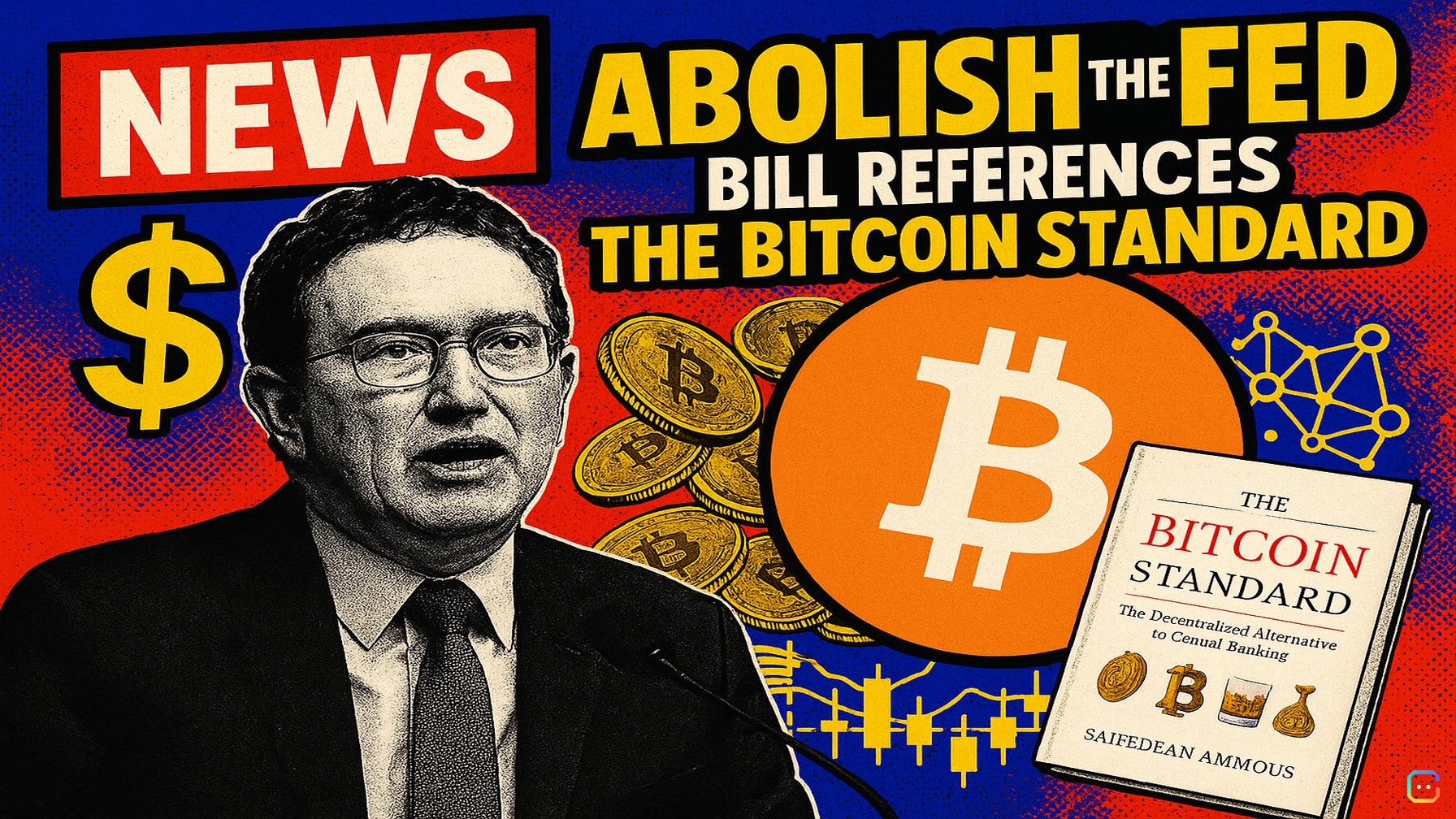
Rep. Thomas Massie’s push to dismantle the Federal Reserve is drawing fresh attention in Bitcoin circles — not because it has a real shot at becoming law, but because of the intellectual signal it sends to the crypto community.
What’s happening
- In March 2025, Massie introduced the Federal Reserve Board Abolition Act, a bill that would eliminate the Federal Reserve Board of Governors and the Federal Reserve banks.
- The move has resurfaced in crypto media after Massie explicitly invoked The Bitcoin Standard — the influential book that has shaped many hard-money arguments within the Bitcoin community — as part of his rationale.
Why Bitcoiners care
Bitcoin’s original political and cultural appeal rests heavily on distrust of central-bank money. Its fixed supply, predictable issuance and absence of a central monetary authority made it attractive to people skeptical of inflation, political interference and credit expansion. The Bitcoin Standard helped translate those technical features into a broader monetary narrative by drawing on monetary history and Austrian economics — turning Bitcoin into a widely shared monetary idea, not just a protocol.
Massie’s reference to that intellectual tradition gives a familiar, political voice to views long circulating in crypto: that the Federal Reserve and fiat monetary policy are fundamentally flawed. For supporters, the bill is a symbolic extension of arguments Bitcoiners have been making for years.
How consequential is the bill?
Realistically, abolishing the Fed is extraordinarily unlikely in the near term. The Federal Reserve is deeply embedded in U.S. financial markets, banking supervision, payment systems and monetary policy; dismantling it would face massive political and institutional obstacles.
But symbolism matters. A bill like Massie’s can:
- Shift public debate and force mainstream engagement with hard-money critiques.
- Give proponents a rallying point and a way to link Bitcoin’s narrative to formal political discourse.
- Reinforce Bitcoin’s identity as an alternative monetary system — an identity that gains traction when inflation, debt or central-bank policy are politically salient.
What it won’t do
This legislation is not comparable to market-moving events like ETF approvals or central-bank rate decisions. Traders should not expect a direct, mechanical impact on Bitcoin’s price. Its primary effect is narrative and political signaling.
Bottom line
Massie’s bill — introduced in March 2025 and revived in discussion by its explicit nod to The Bitcoin Standard — is less about near-term policy change and more about the normalization of Bitcoin’s monetary critique inside American political debate. It’s a reminder that ideas once confined to niche forums are now finding expression in Congress.
Source: Office of Representative Thomas Massie. Article edited by Samuel Rae.
Read more AI-generated news on: undefined/news