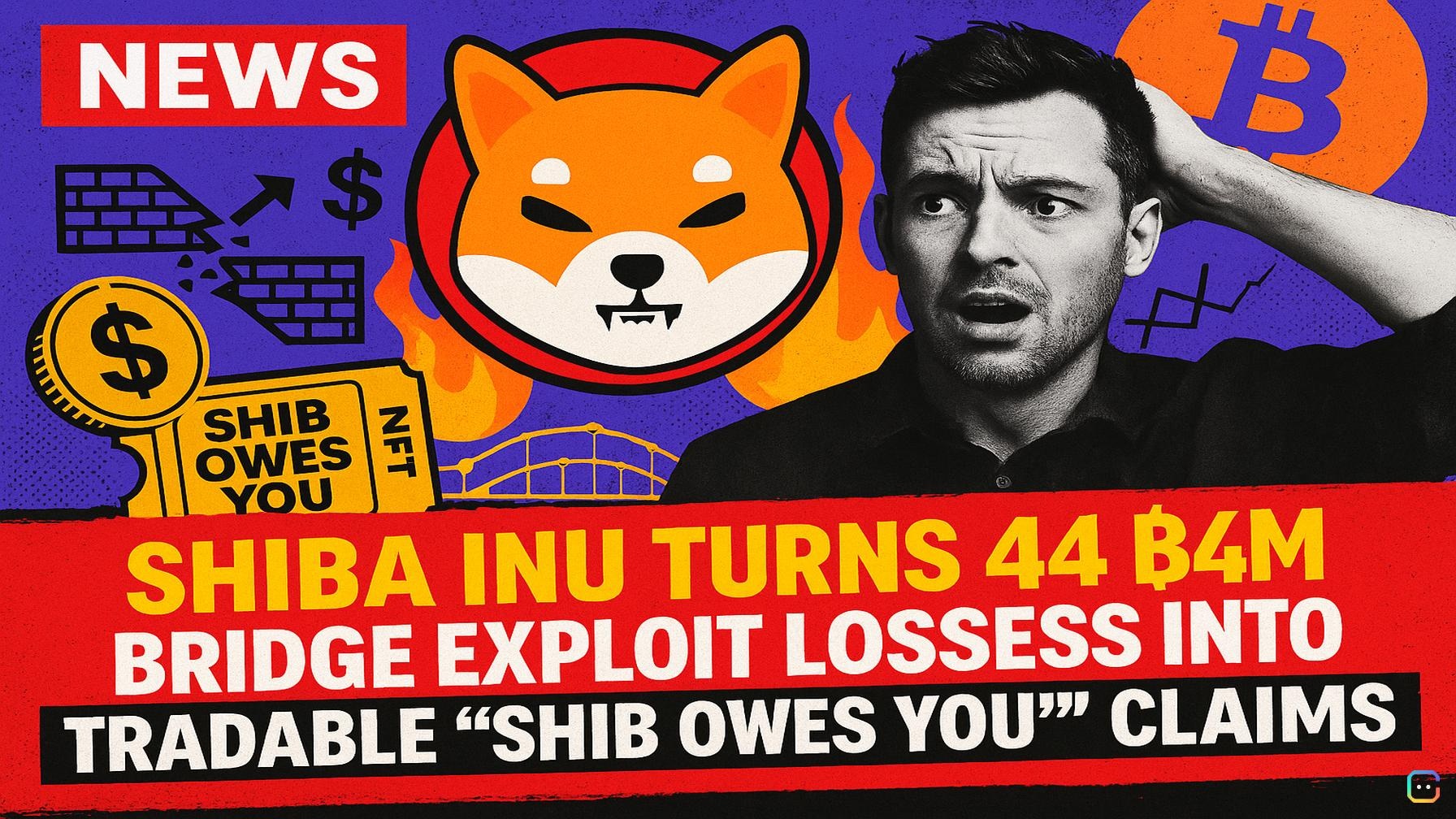
Headline: Shiba Inu turns losses into tradable assets — “Shib Owes You” tokenizes restitution after $4M bridge exploit
Shiba Inu’s recovery from a $4 million bridge exploit in September is taking an unconventional tack: convert verified user losses into on‑chain, tradable assets. On December 29, lead developer Kaal Dhairya revealed “Shib Owes You” (SOU), a financial restructuring plan that tokenizes restitution and could set a long‑term governance precedent by forcing every ecosystem participant to hold skin in the game.
What SOU does
- Verified user losses will be issued as dynamic NFTs on Ethereum — not entries in a private database. As Dhairya put it: “This isn’t a promise in a database somewhere. It’s cryptographic proof that you own a claim, recorded permanently on the Ethereum blockchain.”
- Each debt claim becomes a dynamic NFT (audited by Hexens) that updates automatically as revenue flows into the restitution pool, giving victims real‑time on‑chain visibility into their claims.
- These NFTs are tradable and composable: holders can keep, split, merge or sell claims on a secondary market, enabling faster liquidity for some users and consolidation for others.
Governance and funding shift
- To support the model, Dhairya has enforced austerity rules: all SHIB‑related revenue — including contributions from partner platforms, social channels and ecosystem ventures — must flow into the SOU pool.
- The move targets so‑called “value extractors” and reframes Shiba’s priorities from marketing and growth to restitution and accountability. “If we’re going to ask the community to be patient while we rebuild, then everyone who has access to ecosystem resources needs to be held to the same standard,” Dhairya said.
Security and rollout risks
- The Plasma Bridge has been hardened with a seven‑day withdrawal delay and hardware‑based custody, but the SOU portal itself is not yet live.
- Dhairya warned the community to beware of phishing and fake recovery sites. Although the debt tokens exist in code, claims will remain locked until comprehensive security tests are complete — a deliberate, security‑first phased rollout intended to avoid further failures.
Market response and on‑chain activity
- Rather than triggering panic, the SOU announcement and broader restructuring have seen buy‑side support. At the time of writing, CoinMarketCap lists SHIB at $0.057149, down 4.15% over 24 hours.
- Behind the scenes, December 10 saw heavy whale action: 406 large transfers moved more than 1.06 trillion SHIB into exchanges — flows that would normally presage a sell‑off. Instead, SHIB has largely held its support levels, suggesting both retail “Shib Army” holders and institutional players are defending positions rather than exiting.
Outlook
- The SOU framework is novel and could influence how other ecosystems handle hacks and restitution, but its success hinges on flawless execution, robust audits and a secure, transparent launch of the portal and marketplace.
- For now, the community appears determined to rebuild rather than retreat — but the path forward remains contingent on security checks and the secondary market’s reception.
Disclaimer: This content is informational and not investment advice. Cryptocurrency trading is high risk; do your own research before making financial decisions. © 2025 AMBCrypto
Read more AI-generated news on: undefined/news