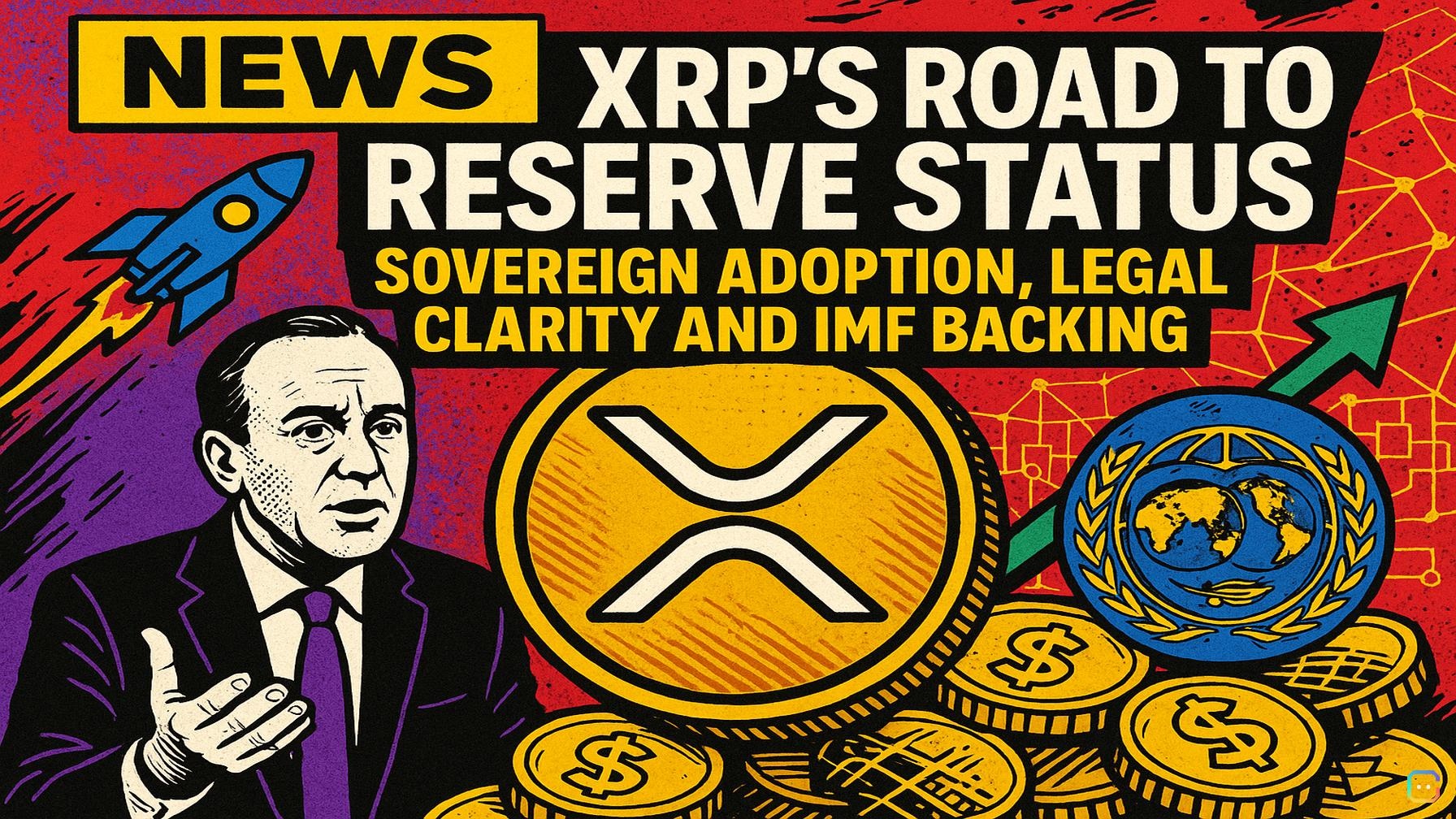
Versan Aljarrah of Black Swan Capitalist is laying out a big-picture case for XRP that goes far beyond the usual market-cycle chatter. In a recent X post titled "How XRP Becomes a Global Reserve Asset," Aljarrah argues XRP’s long-term role could be as a neutral settlement layer in a digitized global financial system—not just a payments token or bridge asset.
Aljarrah says the public debate has been trapped in the wrong frame. “The conversation around XRP is usually clouded by speculation and price predictions,” he wrote. Beneath that noise, he sees a story about regulation, sovereign integration, and institutional acceptance that could elevate XRP into foundational monetary plumbing where liquidity, interoperability and neutrality matter most.
His thesis rests on three pillars: sovereign adoption, regulatory clarity, and institutional recognition—culminating with endorsement from multilateral institutions such as the IMF. In his telling, the process begins with nation-states adopting the ledger for real economic use rather than with retail market enthusiasm.
Reserve status, he stresses, grows from official acceptance, not short-term price action. “Before any asset can become a global reserve instrument, it first needs sovereign legitimacy,” Aljarrah wrote, likening the route to the way gold, the U.S. dollar and SDRs (Special Drawing Rights) derive credibility from state acceptance and usage.
Aljarrah frames cross-border settlement as the immediate use case. He argues emerging markets are exploring blockchain solutions to improve liquidity, cut costs and stabilize currencies—and that XRP’s architecture could serve as a neutral bridge between local currencies. For countries seeking to reduce reliance on dollar-based settlement rails, he suggests, XRP could offer a way to settle value without reinforcing geopolitical dependencies tied to the dollar system. He points specifically to BRICS and other dollar-dependent economies as potential early sovereign adopters.
One of his more assertive claims: “It is not a matter of ‘if,’ but ‘when’ nations begin leveraging XRP to solve monetary inefficiencies.” Aljarrah also asserts that countries have already integrated XRP into some payment rails and used it for cross-border settlements—an assertion he presents as the opening act for broader institutional recognition.
The second pillar is legal clarity. Aljarrah highlights the CLARITY Act as a potential inflection point: if Ripple reduces its holdings enough to satisfy whatever compliance thresholds that framework sets, XRP could appear legally neutral and more accessible to institutions and sovereigns. In his view, lowering Ripple’s on-chain concentration would help position XRP as a non-sovereign, globally usable settlement instrument less likely to trigger securities-law concerns.
Only after sovereign usage and legal clarity, he argues, would institutional recognition—anchored by multilateral organizations like the IMF—push XRP toward reserve status. In a tokenized financial system, Aljarrah suggests, XRP’s valuation would increasingly reflect its settlement utility: liquidity depth, throughput and the volume of value moved across institutional corridors rather than retail-driven price speculation. “Price discovery would shift from noise to institutional liquidity corridors,” he wrote.
He closes by reframing XRP as infrastructure rather than a speculative asset—a component of a potential transition away from a centralized, dollar-dominated order toward a multipolar, interoperable financial architecture powered by neutral settlement technologies.
For XRP watchers, Aljarrah’s argument is explicitly long-horizon: not a short-term trading thesis but a narrative about reserve status, monetary plumbing and the architecture of global liquidity. At press time, XRP traded at $1.3576.
Read more AI-generated news on: undefined/news