Today's Cryptocurrency Prices by Market Caps
The global cryptocurrency market cap today i $2.42T
Market Cap
$2.42T
24h Trading Volume
$92.35B
BTC Dominance
56.57%
|
#
|
Name
|
Price
|
1h %
|
24h %
|
7d %
|
Market Cap
|
Volume (24h)
|
Chart (7d) |
|---|---|---|---|---|---|---|---|---|
|
|
—
|
|||||||
|
No cryptocurrencies found Try adjusting your search query |
||||||||
Latest Crypto News
View All News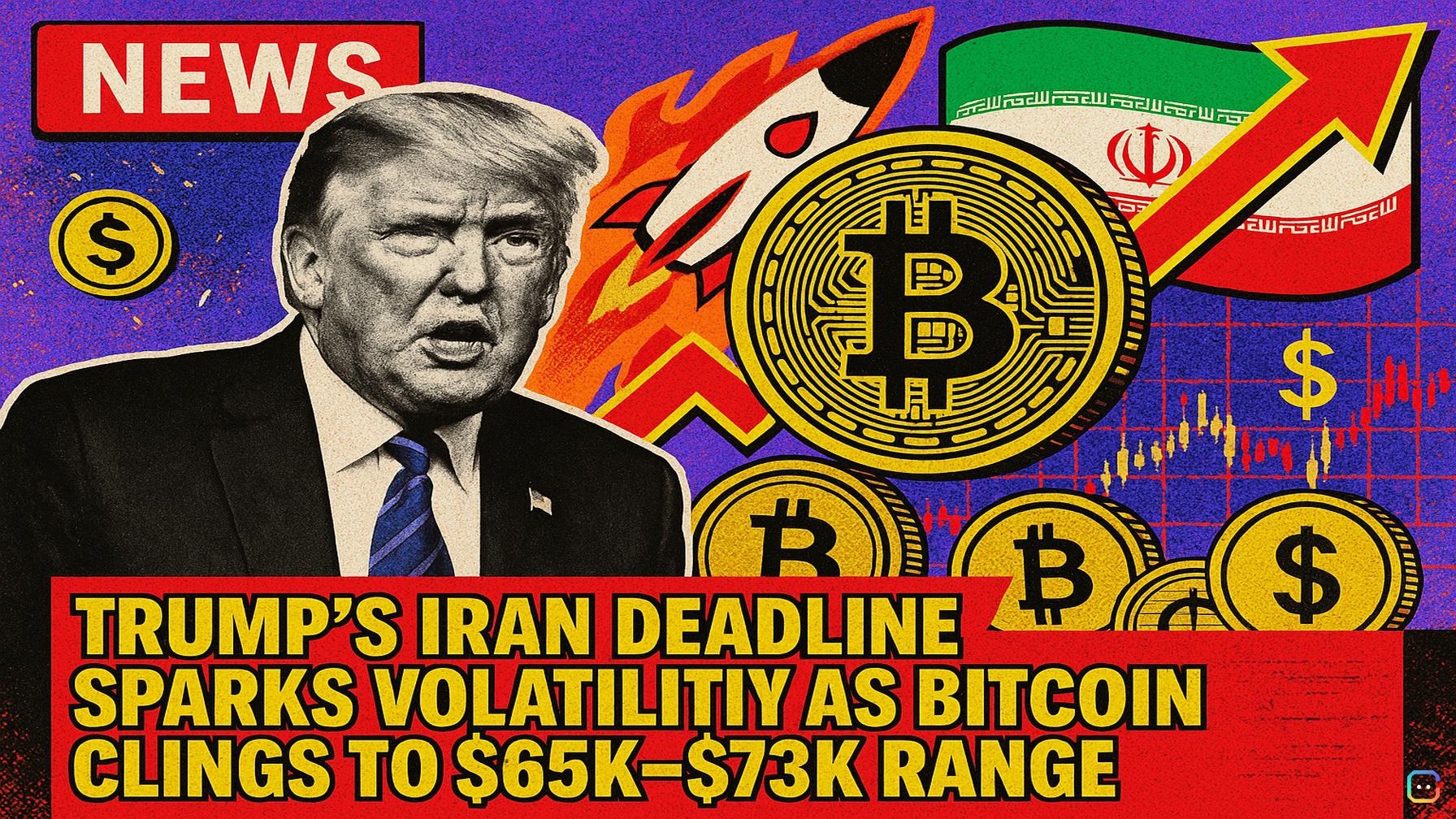
Trump’s Iran Deadline Sparks Volatility as Bitcoin Clings to $65K–$73K Range
Bitcoin and major altcoins held their ground in Asian trading Tuesday as a new geopolitical deadline from U.S. President Donald Trump injected fresh volatility into risk markets. Price snapshot (24-hr moves): Bitcoin dipped 0.6% to $68,589 after peaking at $69,350 on Monday; Ether slipped 1% to $2,104; Solana’s SOL fell 2.7% to $79.75; XRP dropped 1.6% to $1.32; Dogecoin slid 2.2% to $0.09; BNB was relatively flat around $598. Monday’s brief rally followed an Axios report of a possible 45-day ceasefire between Iran and its adversaries. That optimism was short-lived: Trump set a Tuesday night deadline for Iran to accept a deal and warned of severe military action if no agreement is reached, saying he could destroy “every bridge in Iran by 12 o’clock tomorrow night.” The ceasefire momentum reversed after reports that Iran rejected the proposal via mediator Pakistan, demanding a permanent end to war, sanctions relief, reconstruction aid and guaranteed shipping through the Strait of Hormuz. The market reaction fits a familiar pattern from the past six weeks — headlines spark quick rallies that unwind once doubts resurface. “This move looks less like a shift in fundamentals and more like positioning getting caught offsides,” said Diana Pires, chief business officer at sFOX. She noted strong bearish sentiment and built-up short interest going into the weekend, which had to be unwound once ceasefire headlines hit. Monday’s bounce triggered roughly $196.7 million in short liquidations. Macro and commodities also reacted. U.S. crude topped $112 and Brent traded near $115.66, up 2.9% on the session, as oil markets priced in heightened Middle East risk. Trump also warned the military could disable Iranian power plants if no deal materializes. Despite the whipsaw, equities eked out gains: the S&P 500 posted its longest winning streak since January. Economic data added to the uncertainty. U.S. services activity slowed in March, employment contracted at the steepest pace since 2023, and input costs accelerated — a mixed signal that leaves the Fed with little clarity on whether to cut or hold policy. Key inflation readings due this week will be watched closely for guidance. Technically, Bitcoin continues to trade inside a narrow corridor between roughly $65,000 and $73,000 established since the conflict began — every rally has stalled near the top, and every pullback has found support near the bottom. With Trump’s deadline due at midnight Tuesday, traders will be watching which end of that range gets tested next. Read more AI-generated news on: undefined/news
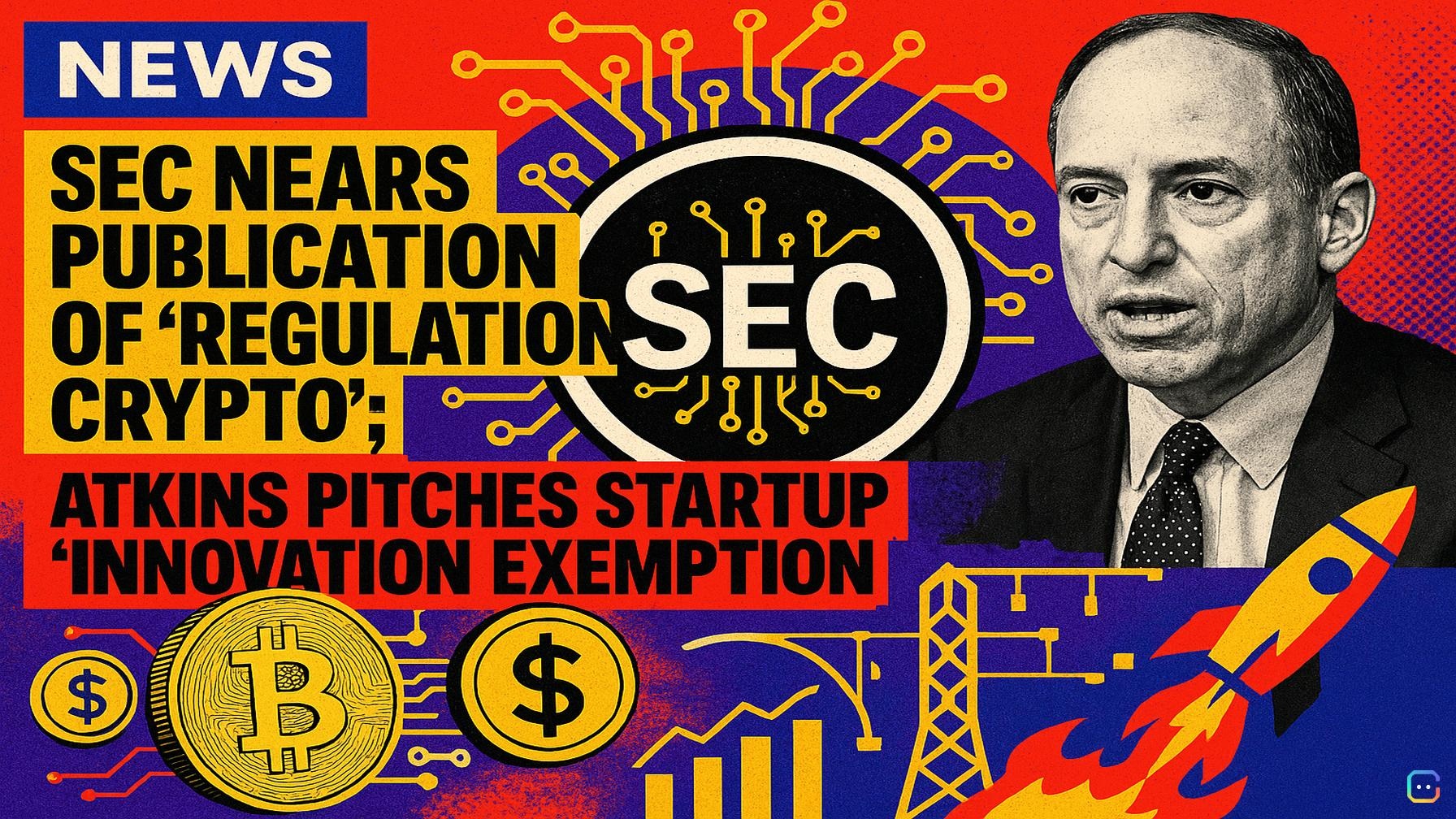
SEC Nears Publication of 'Regulation Crypto'; Atkins Pitches Startup 'Innovation Exemption'
Headline: SEC says “regulation crypto” is one step from publication; innovation exemption also coming, Chair Atkins tells crypto audience The Securities and Exchange Commission is nearing publication of a long-anticipated “regulation crypto” that would clarify how the agency applies securities law to crypto fundraising and related activity, SEC Chair Paul Atkins said Monday in Nashville. Speaking at an event hosted by Vanderbilt University and the Blockchain Association, Atkins said the proposed rule is currently with the White House Office of Information and Regulatory Affairs (OIRA)—meaning it’s one administrative step away from being released. The rulemaking will focus on the Securities Act of 1933 and specifically address fundraising and startup exemptions, he said. Atkins also told CoinDesk after his Q&A that the agency plans to roll out an “innovation exemption” soon. He described the exemption as designed to let startups experiment without being unfairly disadvantaged by incumbents: “We want people really to experiment within [that] framework,” he said, and invited public feedback once it’s published: “We'd love to have reactions and everything else... It's not a rule as such but obviously we need to know how it's functioning and if people have problems with it or not.” On the political front, Atkins repeatedly stressed that the SEC’s rulemaking is moving forward regardless of Congress’s actions, though he encouraged the crypto community to stay politically engaged. He acknowledged potential hurdles—“they can throw tacks on the road in front of our tires but they're not going to really slow us down”—but warned that an unfriendly Congress could inject uncertainty into the sector. Pointing to recent electoral outcomes, he urged attendees to make sure “your friends are in Congress,” noting that supportive representatives have delivered benefits for the industry. What to watch next - Publication of the proposed “regulation crypto” after OIRA clearance. - Details of the rule’s treatment of fundraising and startup exemptions under the Securities Act of 1933. - Release of the innovation exemption and the public comment or implementation period that follows. Implications If finalized, this package could provide clearer guidance on which crypto activities the SEC views as securities-related fundraising, and create a regulatory space intended to let startups test new products without tilting rules toward established firms. For market participants, the incoming guidance and exemption will be key to compliance strategies and capital-raising plans. Atkins’ comments suggest the agency is moving proactively to set crypto policy through rulemaking while inviting industry feedback—an approach that could reshape the regulatory landscape for projects, exchanges and investors once the proposals are published. Read more AI-generated news on: undefined/news

Milei Phone Logs Tie Him to Libra Token Push, Prompting Fraud Probe
Headline: Milei Phone Logs Deepen Scrutiny Over Libra Token Endorsement Newly reviewed phone records have reignited scrutiny around Argentine President Javier Milei’s unexpected promotion of the so‑called Libra token. Prosecutors’ call logs — first reported by The New York Times — show Milei exchanged seven calls with an entrepreneur tied to the Libra project on the same night he posted about the cryptocurrency on X, with calls occurring both before and after the post. Authorities have not released the contents of those conversations. The revelations undermine Milei’s earlier claims that he had no formal connection to the initiative. After the post sparked controversy, Milei said he had merely amplified “an alleged private venture” in a personal capacity, denied any direct ties, and said he stopped promoting the project once he learned more about it. What happened to the token - Milei’s endorsement in February 2025 briefly sent the Libra token sharply higher, as he described it as a potential funding tool for small businesses and startups. - The rally quickly collapsed: the token lost more than 96% of its peak value, wiping out roughly $251 million of investor funds and prompting accusations that the episode resembled a rug pull. Legal and investigatory fallout - Argentine lawyers have filed fraud complaints against Milei and some politicians have demanded impeachment proceedings. - Federal prosecutors opened a formal investigation, naming Milei as a person of interest. The probe is actively examining financial links, communications, and the roles of individuals involved in the token’s launch. - Argentina’s Anti‑Corruption Office concluded in June that Milei did not breach public ethics rules, finding his post was made personally rather than in his role as head of state. New evidence raises questions A March judicial update added another wrinkle: investigators say they found a draft note on the phone of crypto lobbyist Mauricio Novelli that referenced a potential $5 million arrangement tied to the Libra promotion. The document — reportedly drafted three days before Milei’s post — did not identify beneficiaries or clarify the arrangement’s purpose. Why it matters The unfolding investigation highlights persistent governance and transparency challenges in crypto promotions that intersect with high‑profile political figures. Prosecutors are now piecing together communications and financial trails to determine whether coordination or wrongdoing took place, while legal and political consequences for those involved remain possible. Read more AI-generated news on: undefined/news
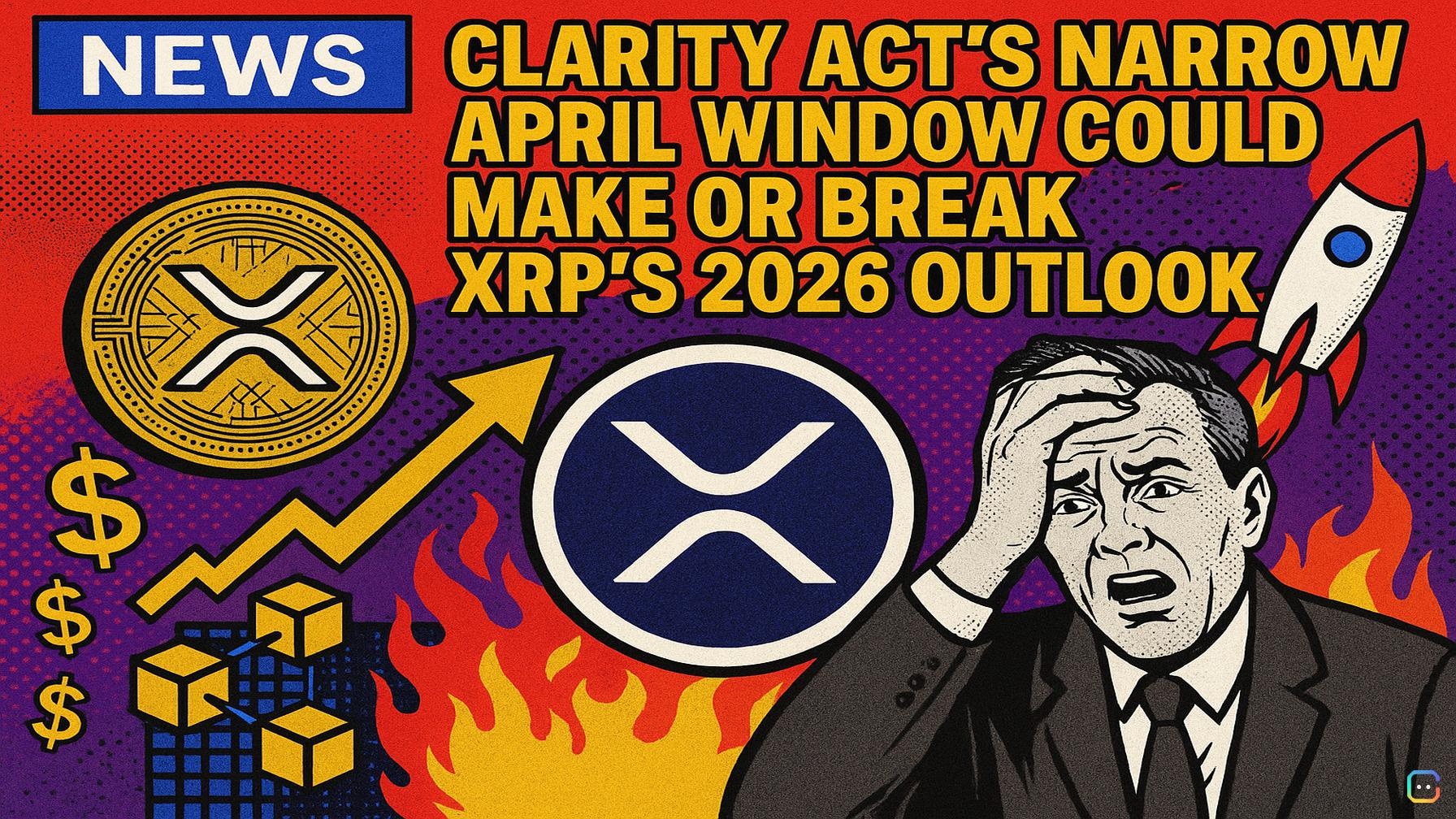
CLARITY Act’s Narrow April Window Could Make or Break XRP’s 2026 Outlook
Headline: Why the Next Three Weeks in the Senate Could Make or Break XRP’s 2026 Outlook The timetable for the CLARITY Act has compressed from months to weeks — and that makes mid‑April to early May the most consequential stretch for XRP this year. XRP traded around $1.34 on April 6 (up about 2.2% on risk‑on sentiment), but remains more than 63% below its July 2025 peak of $3.65. Even after the SEC and CFTC jointly classified XRP as a digital commodity on March 17, Q1 2026 was XRP’s worst quarter in eight years, with market cap down roughly $29 billion, according to 24/7 Wall St. What’s at stake - The Senate returns from Easter recess on April 13, and the Senate Banking Committee is targeting a late‑April markup of the CLARITY Act. That “second half of April” window is widely viewed as the final realistic chance to move the bill forward before midterm politics close the calendar. - Senator Bernie Moreno has warned that if the bill doesn’t reach the full Senate floor by May, it will effectively be dead for 2026. Ripple CEO Brad Garlinghouse likewise pushed his own passage expectation from the end of April to the end of May. - Polymarket currently prices the chance of the CLARITY Act being signed in 2026 at roughly 63–66%. Why legislation matters even after agency guidance Regulatory clarity from the SEC and CFTC helped, but banks and big asset managers reportedly want statutory certainty — not just interpretive releases that a future administration could reverse. The CLARITY Act would provide that durable legal cover and unlock institutional capital that has remained on the sidelines. Key policy compromise A long‑running dispute over stablecoin yields appears to be reaching a settlement: Senators Tillis and Alsobrooks agreed in principle (March 20) on a compromise that would ban passive yield on stablecoin balances while allowing activity‑based rewards tied to payments and platform use. That concession may have cleared a major legislative hurdle. Potential market impact - If the Banking Committee advances the bill in late April, Standard Chartered’s Geoffrey Kendrick estimates it could free $4–8 billion in additional inflows into US spot XRP ETFs. Seven US spot XRP ETFs have already gathered $1.44 billion since their launches between September and December 2025 — and passage would give institutional money permanent legal cover. - Large ETF inflows would lock hundreds of millions of XRP tokens in custody, tightening circulating supply. 24/7 Wall St. says that dynamic could nudge XRP above $1.60 and potentially set it on course toward its prior cycle high. Downside scenarios if the bill stalls - If the CLARITY Act falters past May, analysts say upside becomes much more limited. Standard Chartered’s 2026 target has already been cut from $8 to a best‑case $2.80 amid delay risk. - Without federal legislation, XRP would likely track Bitcoin’s direction. With BTC trading range‑bound between $65,000 and $73,000 and the Fed expected to hold rates through year‑end, a combined stall and a Bitcoin break below $60,000 could see XRP slide toward $0.82, per 24/7 Wall St. The clock is tight “As April is the narrowest window XRP has had for that to change,” 24/7 Wall St. writes, the coming weeks will determine whether Q2 begins with the legislative certainty that Q1 lacked — or whether XRP must wait much longer for a defining regulatory outcome. Read more AI-generated news on: undefined/news
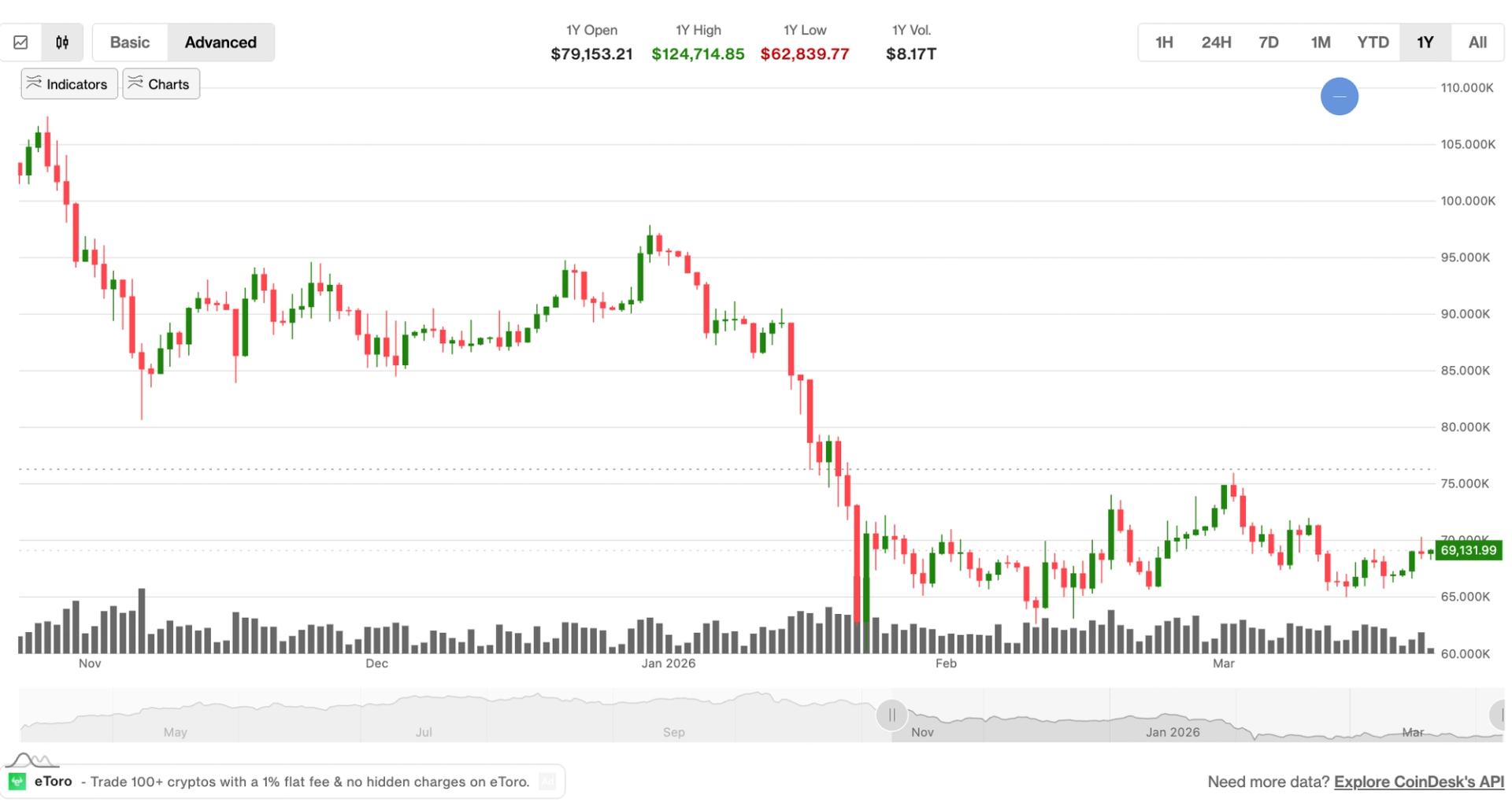
Bitcoin price-drop speculation spurred by familiar price pattern
BTC and ETH remain stuck in a two-month range as oil prices and Iran tensions weigh on sentiment, while AI and privacy tokens show surprising relative strength.

Bernstein sees over 100% upside for Figure as monthly loan volume tops $1 billion for first time
Bernstein reiterated a $67 price target on Figure as March loan volume topped $1 billion for the first time.