Today's Cryptocurrency Prices by Market Caps
The global cryptocurrency market cap today i $2.62T
Market Cap
$2.62T
24h Trading Volume
$101.66B
BTC Dominance
57.22%
|
#
|
Name
|
Price
|
1h %
|
24h %
|
7d %
|
Market Cap
|
Volume (24h)
|
Chart (7d) |
|---|---|---|---|---|---|---|---|---|
|
|
—
|
|||||||
|
No cryptocurrencies found Try adjusting your search query |
||||||||
Latest Crypto News
View All News
Plaintiffs Sue Circle Over $230M USDC Exodus After Drift Exploit
A new class-action lawsuit is putting Circle squarely in the spotlight after roughly $230 million in stolen USDC moved across chains in the wake of the April 1 Drift Protocol exploit. What’s being alleged In a complaint filed in U.S. District Court in Massachusetts, Drift investor Joshua McCollum — representing more than 100 affected users — says Circle failed to stop the post-hack movement of about $230 million in USDC. The suit claims attackers routed funds across chains using Circle’s Cross-Chain Transfer Protocol (CCTP) over several hours, allowing the perpetrators to reposition assets “without disruption.” Lawyers for the plaintiffs, led by Mira Gibb, assert that timely intervention from Circle could have prevented or substantially reduced the losses. The complaint brings counts including negligence and aiding and abetting conversion; damages will be decided at trial. Precedent and capability questions Plaintiffs point to an action by Circle roughly a week before the Drift incident — when the firm froze 16 USDC-linked wallets tied to a sealed civil case — as proof the company had both the technical capability and operational precedent to act. That contrast is central to the suit’s contention that Circle “permitted this criminal use of its technology and services.” The Drift exploit and on-chain trail The legal dispute traces to a large-scale exploit of Drift, a Solana-based trading protocol, in which attackers drained more than $285 million — over half of the platform’s total value locked (TVL) at the time. DeFiLlama data cited in reports show Drift’s TVL has since fallen to around $251 million from a $1.5 billion peak recorded in September 2025. On-chain investigators say the attacker rapidly converted stolen assets into stablecoins including USDC, bridged portions to Ethereum, swapped some into Ether, and routed proceeds through privacy tools such as Tornado Cash. Blockchain analytics firm Elliptic linked the movement to suspected North Korean state-backed actors and noted that more than 100 transactions passed through Circle’s infrastructure during U.S. working hours. Immediate response and community reaction Drift confirmed the attack as it was unfolding, pausing deposits and withdrawals and engaging security firms and exchanges. The team warned users not to interact with the protocol and security researchers urged revoking wallet approvals and avoiding the platform until it was safe. The broader freeze debate The case revives a perennial question in crypto: how much responsibility do stablecoin issuers carry when they retain the technical ability to freeze tokens at the contract level? Circle and other issuers face a trade-off — freezing assets can curb immediate criminal activity but acting without legal orders risks regulatory pushback and reputational damage. Lorenzo Valente, director of digital asset research at ARK Invest, summed up the dilemma: every freeze is a judgment call and every non-freeze can be taken as a political statement. “Whether Circle got it right comes down to how much you weigh rule-of-law principles vs concrete harm. Reasonable people disagree,” he said. Drift’s recovery playbook and market signals In the wake of the exploit, Drift has pivoted away from reliance on Circle’s infrastructure. The protocol has secured nearly $150 million in fresh backing to fund recovery and relaunch plans, including $127.5 million from Tether. The money is earmarked for compensating affected users and shifting settlement to USDT on Solana. The recovery roadmap includes a revenue-backed credit line, liquidity support for market makers, ecosystem grants, and a recovery token that will let affected users claim from a pool supported by trading fees and the newly raised capital. Tether CEO Paolo Ardoino said the objective is to restore stability and rebuild trust with a relaunch “aligned with real activity and long-term growth.” Market reaction has been swift: DRIFT token prices climbed roughly 20% to above $0.061 — its highest level since the day of the exploit — as investors priced in the recovery funding and relaunch prospects. What’s next The class action will test legal expectations around issuer intervention in the aftermath of hacks and may influence future industry practice on when and how stablecoin issuers exercise freezing powers. Meanwhile, Drift’s recovery plans and Tether’s sizable backing will be watched closely as the protocol attempts to rebuild liquidity and user confidence. Read more AI-generated news on: undefined/news
House Narrowly Rejects War-Powers Resolution to Pull Forces From Iran, Crypto Markets on Edge
The House on Thursday narrowly rejected a war-powers resolution that would have ordered President Trump to withdraw U.S. forces from hostilities with Iran, voting 213–214 along almost entirely partisan lines. The outcome mirrored the Senate’s 52–47 rejection of a similar measure the day before and leaves no clear congressional off-ramp for the conflict. What happened - Rep. Gregory Meeks (D‑N.Y.) sponsored the resolution and argued on the House floor that “Donald Trump has dragged the American people into a war of choice, launched without congressional authorization.” - The vote split almost perfectly by party: Rep. Thomas Massie (R‑Ky.) was the lone Republican to back the resolution; Rep. Jared Golden (D‑Maine) was the only Democrat to vote against it. Rep. Warren Davidson (R‑Ohio) voted “present,” and three Republicans did not cast votes—absences that tightened the margin and turned what could have been a three‑vote failure into a one‑vote miss. - Democrats framed these war‑powers measures largely as political pressure tactics to force Republicans to record their stance on the Iran conflict; Republicans have repeatedly defended the president’s military authority in these procedural votes. Constitutional and political context - Under the Constitution, Congress has the power to declare war, while presidents retain limited unilateral authority for immediate self‑defense. Legal experts argue, however, that prolonged offensive operations generally require congressional authorization. Democrats have repeatedly invoked the 1973 War Powers Resolution to trigger these votes. - The issue is politically fraught heading into the 2026 midterms: rising gas, diesel and fertilizer costs tied to the conflict and the Strait of Hormuz disruptions have fueled economic anxiety in key districts, becoming a liability for Republicans and weighing on presidential approval ratings. Market implications for crypto and broader markets - Financial markets have priced the Iran war as the dominant geopolitical risk for 2026. Oil, equities and crypto are reacting not only to battlefield and diplomatic developments but also to congressional signals on U.S. involvement. - The failed House resolution removes one potential near‑term political catalyst for de‑escalation. That said, a separate announcement of an Israel‑Lebanon ceasefire provided a larger market‑moving signal on Thursday. - Crypto’s sensitivity to geopolitical news is evident: Bitcoin rallied roughly 5% to about $74,400 after an earlier Iran peace signal, and traders continue to treat ceasefire or escalation headlines as major macro drivers. With no legislative route to end U.S. involvement, market participants will be watching diplomatic tracks—including a U.S.‑Iran ceasefire framework and possible resumed talks in Islamabad—for signs of easing risk. Bottom line The House vote keeps the status quo: Congress has not constrained U.S. military action in Iran, and markets — from oil to Bitcoin — are pricing in the ongoing geopolitical uncertainty. For crypto traders and investors, that means heightened sensitivity to diplomatic developments and any congressional movement that could meaningfully change the risk landscape. Read more AI-generated news on: undefined/news
Kennedy Faces Bipartisan Grill Over $16B HHS Cuts — Midterm Politics That Could Stall Crypto Rules
Health Secretary Robert F. Kennedy Jr. endured a bruising first test on Capitol Hill Thursday as Congress dug into roughly $16 billion in proposed cuts to the Department of Health and Human Services (HHS) and probed his vaccine positions. Quick snapshot - Trump administration’s 2027 budget requests $111.1 billion in HHS discretionary spending — a 12.5% cut from 2026. - The proposal trims about $16 billion across HHS, including a contested $5 billion reduction to the National Institutes of Health (NIH). - Kennedy faces a week of hearings: Thursday’s Ways and Means session was followed by an Appropriations subcommittee hearing and at least seven appearances across both chambers; he’s also slated to testify before the Senate Finance and HELP Committees on April 22. What happened in the hearing Kennedy framed the cuts as a deliberate “structural shift” away from existing federal strategies, saying his agenda aims to “put the health of Americans first” and to reverse policies he blames for a chronic disease rise. But lawmakers from both parties pressed him hard on specifics. The NIH cut — the largest single line item under fire — drew bipartisan pushback. Members warned that reducing NIH funding could slow basic medical research at universities and private labs, with downstream effects on drug development and scientific innovation. Kennedy was unusually candid about his discomfort with certain Trump budget priorities, saying he was “not happy” about proposed reductions to nutrition programs like WIC and SNAP. Rep. Gwen Moore pressed him on how those cuts square with his stated goal of fighting childhood chronic disease; Kennedy did not offer a concrete fix. Vaccine questions and optics Vaccine policy dominated parts of the questioning, but Kennedy largely dodged detailed engagement. Republican Rep. Tim Murphy used the moment to attack former NIAID Director Anthony Fauci, while Democratic Rep. Linda Sánchez delivered a memorable rebuke: she criticized Kennedy for suspending a pro-vaccine messaging campaign even as HHS paid for a promotional video showing him shirtless in a hot tub with Kid Rock. Political calculus and intra-administration friction The hearings come amid signs of strain within Kennedy’s MAHA coalition and caution from the White House. Advisers have reportedly told Kennedy and HHS officials to avoid publicly pushing controversial vaccine reforms until after the November midterms — suggesting some of his positions are seen as electoral liabilities. Kennedy’s performance carries career risk as well as policy consequences. The White House has shown little tolerance for officials who struggle before Congress, and observers are watching to see if he can withstand sustained bipartisan scrutiny. Wider implications: research, AI pipelines and policy bandwidth Beyond optics, the NIH funding cut has concrete implications: reduced federal support could slow AI-driven medical research pipelines that have expanded with recent federal grants. That matter intersects with broader agenda battles on the Hill — from FISA reauthorization to budget reconciliation and the CLARITY Act — all competing for limited legislative bandwidth in a politically compressed calendar. For crypto watchers, the hearing is also a reminder of how the midterm calendar shapes messaging and regulatory moves across the administration. The same political timeline that has Kennedy tamping down controversial public stances is influencing how the White House and agencies approach high-profile issues from healthcare to crypto regulation. Bottom line Thursday’s hearings were an early, high-stakes gauge of whether Kennedy can defend major budget cuts and controversial policy positions under bipartisan scrutiny. The fate of NIH funding, nutrition programs, and vaccine messaging — plus the broader signal sent to agency officials and regulated industries — will play out in the week’s marathon of hearings and in the policy fights to come. Read more AI-generated news on: undefined/news

Ethereum Foundation Probe Finds ~100 Suspected DPRK Developers Secretly Embedded in Web3
Headline: Ethereum Foundation-backed probe spots 100 suspected DPRK developers quietly embedded across crypto A six-month, Ethereum Foundation–funded investigation has identified roughly 100 individuals tied to the Democratic People’s Republic of Korea (DPRK) who were operating inside Web3 teams under false identities, highlighting persistent and pragmatic security risks across the industry. What was done - The ETH Rangers initiative—launched late 2024 to support public-goods security research—funded a stipend program for independent investigators. One recipient used that funding to create the Ketman Project, a security-focused effort that hunted for “fake developers” in Web3 organizations. - Over six months the Ketman Project flagged about 100 suspected DPRK IT workers and contacted 53 crypto projects that may have unwittingly employed them. The Ethereum Foundation called the work “directly address[ing] one of the most pressing operational security threats facing the Ethereum ecosystem today.” What the investigation found - The probe’s findings add to growing evidence that DPRK-linked developers have been embedding themselves across crypto for years, frequently blending into teams through legitimate technical contributions coupled with fabricated or layered identities. - Security researcher and MetaMask developer Taylor Monahan has previously said DPRK-linked contributors date back to the early DeFi era, with more than 40 platforms having relied on such contributors at various times. She notes that claims like “seven years of blockchain dev experience” are often accurate—the deception is in the identity and intent, not necessarily the skills. - Independent investigator ZachXBT emphasized the low-tech, persistent nature of many operations: “basic and in no way sophisticated,” but “relentless.” Tactics and real-world impacts - Analysts say these campaigns rely heavily on social engineering, identity layering and persistence rather than exotic technical exploits. Typical outreach vectors include job applications, LinkedIn, email, and remote interviews—methods that allow operatives to gradually build trust. - The report points to serious consequences: R3ACH analysts estimate DPRK-linked activity has been associated with roughly $7 billion in stolen crypto since 2017, including high-profile incidents such as the $625 million Ronin Bridge exploit, the $235 million WazirX breach and the $1.4 billion Bybit incident. - Recent attacks underscore the risk. Drift Protocol’s $280 million exploit has been linked to a North Korean-affiliated group that used intermediaries and carefully constructed professional identities to gain credibility before striking. How these operatives hide in plain sight - Ketman’s research surfaced practical indicators for spotting suspicious developer accounts: repeated use of the same avatars or profile metadata across multiple GitHub accounts, accidentally exposing unrelated email addresses during screen sharing, and system language or locale settings that contradict a claimed nationality. - To help the industry detect such behavior, the Ketman Project released an open-source tool to flag suspicious GitHub activity and co-authored an industry framework for identifying DPRK-linked IT workers in partnership with the Security Alliance. Why it matters - The investigation highlights a persistent operational-security vector for crypto projects: threat actors who weaponize legitimate technical talent and standard hiring channels. Even skilled teams can be exposed if vetting focuses solely on code contributions rather than identity and behavioral signals. - The Ethereum Foundation’s support of independent research through ETH Rangers points to a broader recognition that defending public-good infrastructure requires ongoing investment in both tooling and human-centered threat analysis. Bottom line Projects should strengthen onboarding, vetting and monitoring practices—combining technical audits with better identity and behavioral checks—while the industry adopts shared detection tools and frameworks to blunt these low-tech but high-impact infiltration strategies. Read more AI-generated news on: undefined/news
Asymmetric Founder Joe McCann Questioned in Zanzibar After Fiancée’s Death; Passport Retained
Headline: Crypto Fund Founder Joe McCann Questioned After Fiancée’s Death in Zanzibar; Investigation Ongoing Joe McCann, founder of crypto hedge fund Asymmetric, is being questioned by Tanzanian authorities after his fiancée, 31-year-old Ashly Robinson, died in a Zanzibar hospital on April 9. Hotel staff had found Robinson unresponsive in her room the previous day. Police described the incident as a suspected suicide but say inquiries are ongoing. According to authorities, Robinson was discovered with a belt around her neck; hotel staff alerted management and she was taken to hospital. Officers said staff reported the couple had a “misunderstanding” shortly beforehand and were staying in separate rooms. Police have retained McCann’s passport while they await autopsy and forensic results, a move that prevents him from leaving the country. Investigators have not announced any charges. Robinson’s family has strongly disputed the official account. Her sister, Alyssa Endres, told NBC News, “none of this makes sense,” noting that Robinson had recently celebrated a birthday and become engaged to McCann just days before her death. The case has also renewed attention on McCann’s professional background. He founded Asymmetric, a crypto-focused hedge fund that publicly acknowledged heavy losses over the past year—at one point disclosing declines of as much as 80%—and altered its trading strategy last July after investor pushback. A previously announced plan tied to McCann to take a Solana treasury firm public via a merger was quietly shelved in August; no formal explanation was provided. Authorities stress the investigation is active and that they are waiting for full forensic results before drawing conclusions. We will monitor developments and report any material updates. Read more AI-generated news on: undefined/news
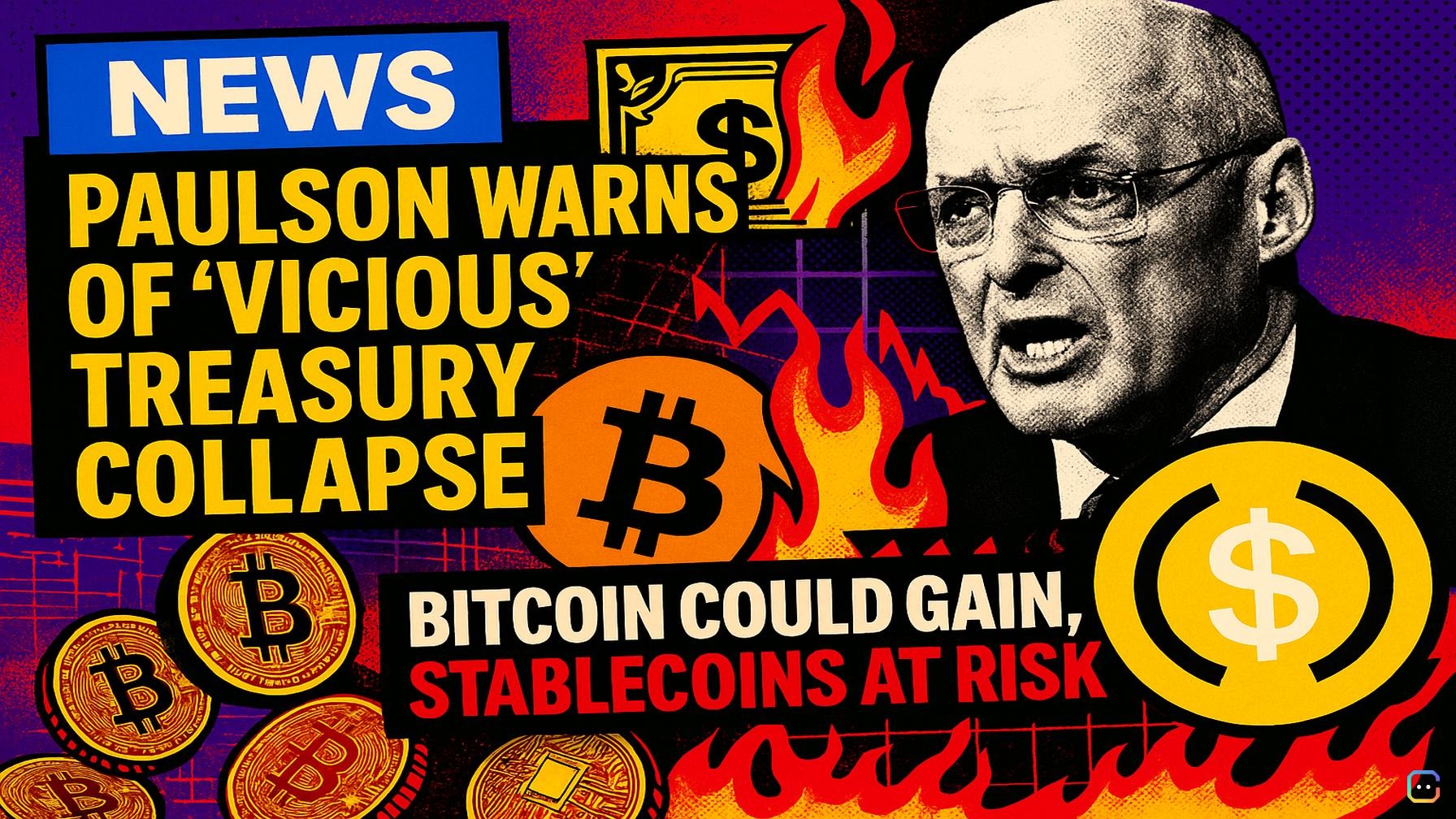
Paulson Warns of 'Vicious' Treasury Collapse — Bitcoin Could Gain, Stablecoins at Risk
Former Treasury Secretary Henry Paulson has sounded the alarm: U.S. policymakers should have an “emergency break-the-glass” plan ready in case demand for Treasurys suddenly collapses — because if it does, “it will be vicious.” Why it matters - U.S. government debt has surpassed $39 trillion, stoking concerns about long-term demand for Treasurys. Those securities aren’t just government IOUs — they are the backbone of global finance and the pricing reference for corporate bonds, mortgages and equities. Any stress in the Treasury market can ripple across the entire financial system. - Economists warn of a dangerous feedback loop: rising debt forces investors to demand higher yields, which raises borrowing costs and widens deficits, further eroding demand. In a severe sell-off the Federal Reserve could be forced to act as a buyer of last resort, absorbing supply to stabilize markets. Paulson’s ask In a Bloomberg interview, Paulson urged authorities to have a targeted, short-term “break-the-glass” framework on standby — a predefined, temporary intervention to deploy only in moments of extreme stress. What this means for crypto - Upside: A loss of confidence in U.S. debt or renewed monetary expansion could push capital toward alternative stores of value. Bitcoin and gold may benefit as investors seek non-sovereign hedges against inflation and dollar weakness. - Downside: Crypto isn’t isolated. Stablecoins create a direct connection between digital assets and U.S. government debt. Tether — the largest stablecoin issuer — keeps a significant portion of its reserves in Treasurys, including Treasury bills and overnight reverse repurchase agreements. Stress in the Treasury market could therefore transmit to stablecoin liquidity and broader crypto market functioning. Policy response in motion U.S. Treasury officials have already taken steps to improve market functioning. On Thursday they executed a large-scale debt buyback, accepting $15 billion of older securities maturing 2026–2028 — the largest such operation to date. The aim: retire less-liquid bonds, inject cash, and give investors more flexibility to reallocate capital. Liquidity measures like this are intended to ease immediate strain, but long-term demand concerns remain central to policy debates. Bottom line for crypto users and traders Treasury-market stress would be a macro event with both risk and opportunity for crypto. While safe-haven flows could lift Bitcoin, contagion through stablecoins and liquidity channels could amplify downside in volatile markets. Investors and platforms should watch policy moves, reserve compositions (especially of major stablecoins), and liquidity conditions in both traditional and crypto markets. Read more AI-generated news on: undefined/news