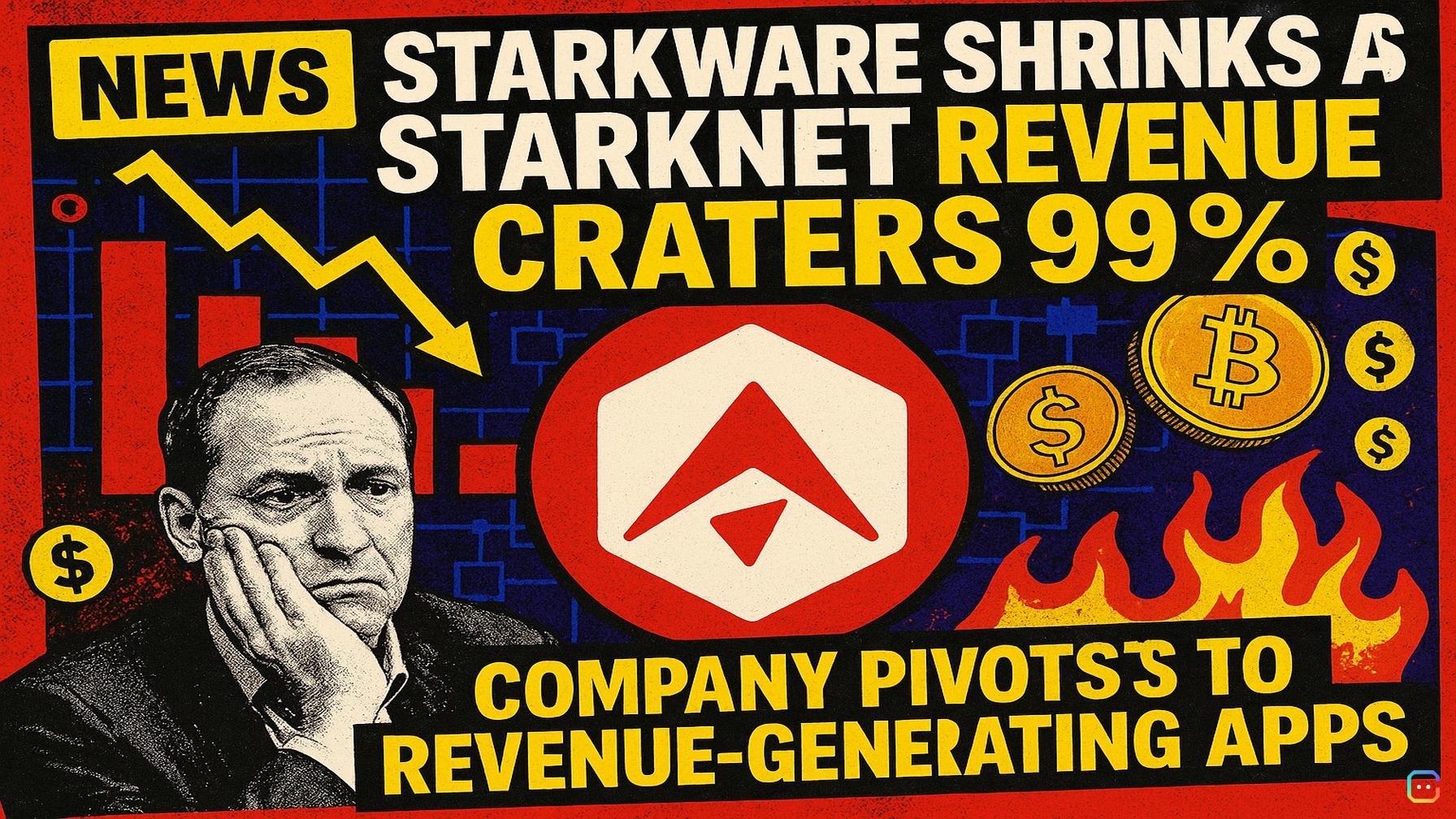
StarkWare is shrinking and refocusing after Starknet revenue cratered more than 99% from its late‑2023 peak, the company revealed in an internal town hall.
CEO Eli Ben‑Sasson told employees the firm will reorganize into two independent business units, trim headcount and pivot away from a pure scaling/infrastructure play toward building revenue‑generating products in‑house. CoinDesk reviewed a transcript of the town hall.
A steep fall in layer‑2 fee income underlies the move. Starknet’s monthly revenue, which topped roughly $6 million at its late‑2023 peak, was about $48,000 through the first half of April 2026, according to DefiLlama. The collapse is not unique to Starknet: Ethereum’s EIP‑4844 upgrade in March 2024 broadly reduced Layer‑2 fee revenue across competing networks. Starknet’s Total Value Locked (TVL), however, remains above $200 million.
Ben‑Sasson framed the reorg as a survival and opportunity play. “We need to take our technological superiority… and convert it into meaningful revenue, meaningful usage,” he said, signaling a shift from experimenting across many fronts to concentrating resources on a smaller set of products that can “be done by no other team, in no other way” and that have “immense potential revenue.”
As part of the change, StarkWare will launch an Applications unit focused on revenue‑driving products. The unit will be led by researcher Avihu Levy, who recently published a paper on “Quantum Safe Bitcoin” (QSB). QSB proposes replacing conventional signature schemes with hash‑based proofs to protect bitcoin transactions from future quantum attacks. The approach could sidestep protocol changes, but Levy’s paper notes major tradeoffs: substantial off‑chain computation and per‑transaction costs estimated in the $75–$200 range, versus roughly $0.33 for a standard bitcoin payment today.
QSB is presented as an alternative to BIP‑360, a longer‑running proposal for protocol‑level quantum resistance that was added to Bitcoin’s improvement proposal repository in February but could take years to activate. Ben‑Sasson did not say the Applications unit will target Bitcoin or quantum safety specifically; he emphasized a broader strategy of building products with minimal dependencies on external layer‑1s or application teams. He also said more details will be shared next week.
Ben‑Sasson framed the move against a wider “winter” for crypto, saying the industry faces a “very clear vacuum in leadership across blockchain.” A spokesperson for StarkWare declined to comment.
Read more AI-generated news on: undefined/news