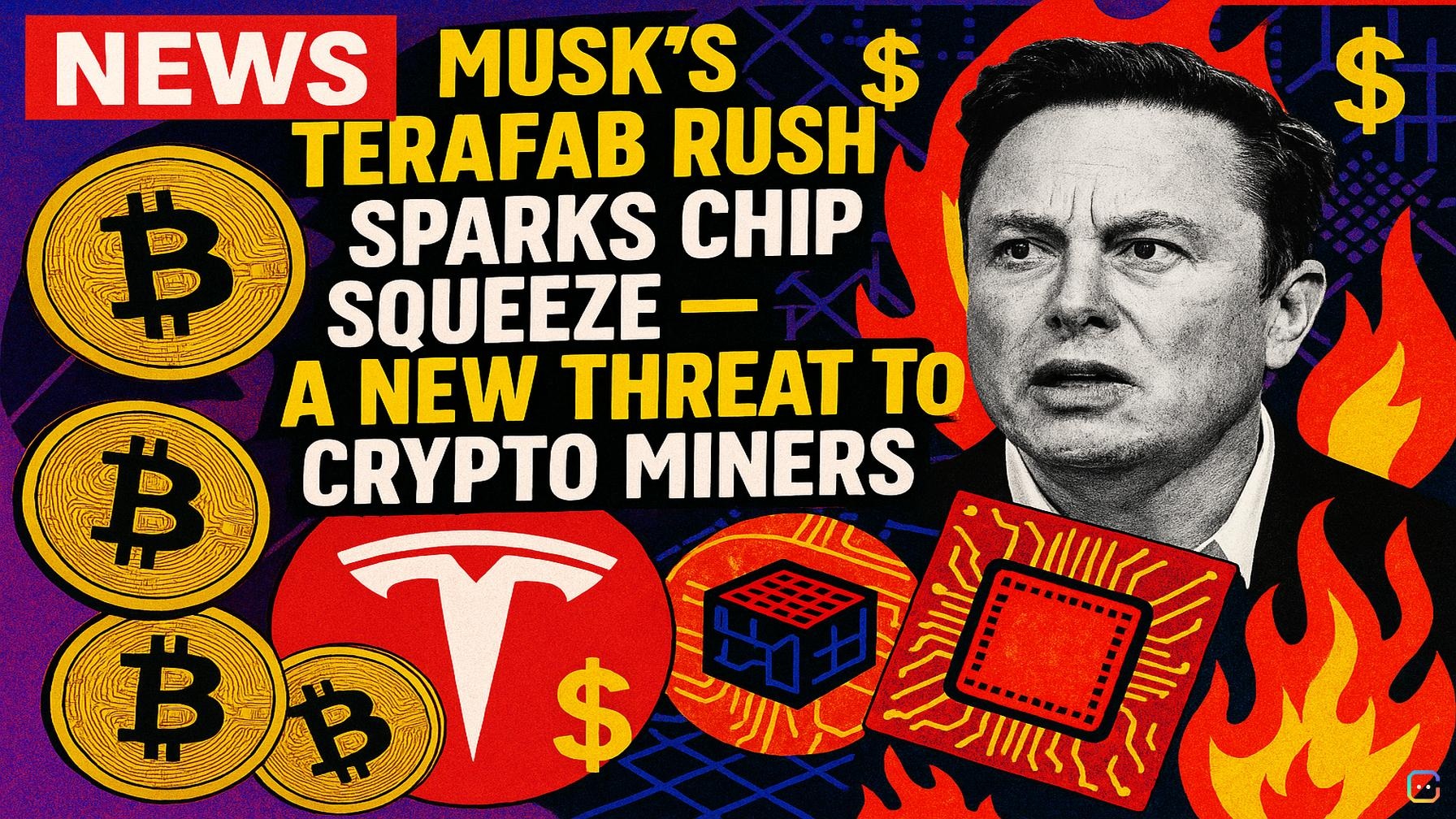
Musk’s Terafab has moved from bold concept to an urgent supply-chain push — and it’s already rattling chip suppliers and crypto markets.
What happened
- Bloomberg reported April 16 that xAI Terafab teams have begun contacting major equipment makers — Applied Materials, Tokyo Electron and Lam Research — to get price quotes and delivery windows for a wide range of chipmaking gear (photomasks, substrates, etchers, depositors, cleaning tools, testers, etc.).
- The outreach has been unusually aggressive: teams have asked for estimates on tight deadlines (one supplier said staff requested quotes on a holiday Friday with delivery by the following Monday), and Musk’s representatives told vendors the project must move at “light speed.” Terafab has even offered to pay “considerably above quoted amounts” to secure priority service.
- These interactions mark the first concrete step from announcement to procurement planning. No formal orders have been placed, and providers are being given only minimal information about what the fab will actually produce — a sign the venture is still in early stages.
The ambition — and the skepticism
- Terafab is a $25 billion joint venture between Tesla, SpaceX and xAI unveiled by Musk at Giga Texas in March 2026. The goal: a vertically integrated factory that combines design, fabrication, packaging and advanced logic to deliver one terawatt of annual AI compute — roughly 50x current global AI chip production, Terafab says.
- Intel joined April 7 as foundry partner, contributing its 18A process node — the most advanced full-US logic manufacturing capability available. Samsung was approached for direct support but declined, instead offering to allocate extra capacity for Tesla at its planned Taylor, Texas facility.
- Established chipmakers have been cautious. Bernstein Research estimated the real capital needed to reach one terawatt at about $5 trillion — roughly 200 times Terafab’s cited $25 billion budget. Analysts such as Tammy Qiu at Berenberg say they haven’t yet baked Terafab into financial models for equipment suppliers like ASML, whose EUV tools would likely be required at scale.
Project timeline and market reaction
- Terafab reportedly plans a pilot line first, capable of processing about 3,000 wafers per month, with silicon chip manufacturing targeted to begin by 2029. Intended uses include chips for Tesla Full Self-Driving, Optimus robots, and SpaceX/xAI infrastructure.
- The supplier outreach pushed Tokyo Electron shares up 5.3% in Tokyo; Applied Materials, Lam Research and other equipment makers also ticked higher. Wedbush analyst Dan Ives called the contacts an early step in Tesla’s long-term AI infrastructure push.
Why crypto traders and miners should care
- The Terafab buildout underscores a broader, industry-wide squeeze on advanced fabrication capacity. High-end AI accelerators, GPUs and ASICs for Bitcoin mining all compete for the same cutting-edge semiconductor processes and toolsets.
- If Terafab succeeds in locking up capacity or driving up demand for scarce equipment (especially EUV tools), it could tighten supply and raise costs for miners and AI rivals alike. That increases the odds that whoever secures the most chip supply at scale will gain a major competitive edge — shaping both AI platform dominance and which crypto-mining operations can remain cost-competitive.
Bottom line
Terafab’s outreach is the clearest sign yet that Musk’s megaproject is trying to move fast — and suppliers are already reacting. But the scale, cost and technical hurdles remain enormous, and the race for limited fab capacity will be a key factor for both AI firms and the crypto-mining industry going forward.
Read more AI-generated news on: undefined/news