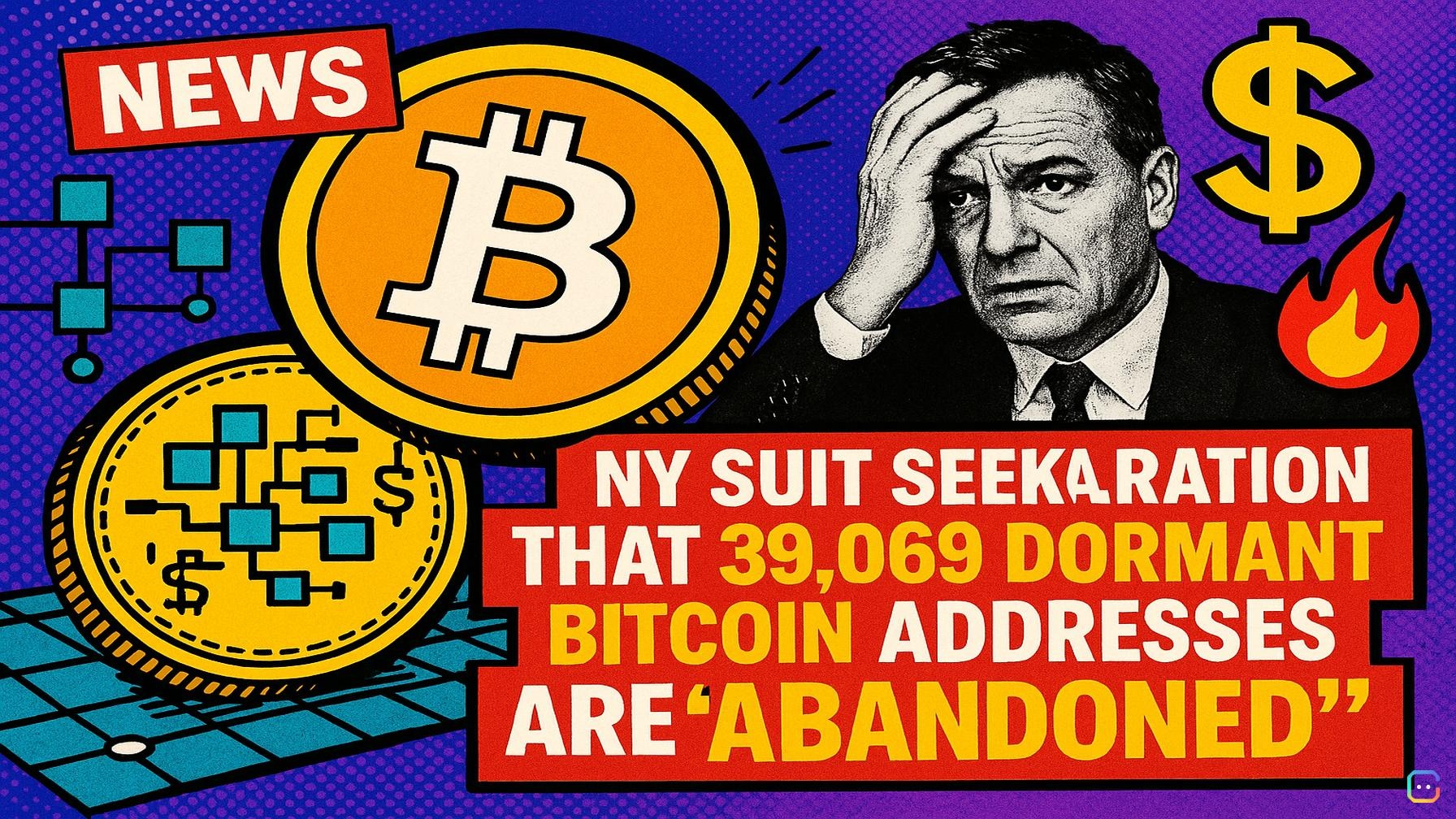
A New York lawsuit is asking a court to declare tens of thousands of long‑dormant Bitcoin addresses “abandoned,” thrusting an unusual property claim into the middle of the Bitcoin community and raising hard questions about what inactivity on‑chain means in law.
What’s in the case
- Plaintiffs: “Noah Doe” plus two Wyoming LLCs (ABC Company and XYZ Company). The filing is a summons and amended complaint asking the New York Supreme Court for declaratory relief — it is not a court order transferring ownership.
- Respondents: listed generically as “John Does 1–39,069.”
- Subject: 39,069 self‑custodied Bitcoin addresses the plaintiffs say are abandoned after a culling process that began with three discovered groups of wallets identified between December 2024 and April 2025 (initial groups: 1,625 wallets — 1,544 after duplicates; 546 wallets; and 39,911 wallets).
- Legal theory: plaintiffs say they followed New York lost‑and‑found procedures, reported the lists to the NYPD on three occasions (via USB drives that were later returned), and that title vested under New York Personal Property Law § 257 before rights were assigned to the LLCs.
Why this drew attention
An outside analysis operator, Sani of TimechainIndex.com, tweeted that the addresses in the filing collectively hold about 3,791,121.17697938 BTC and include wallets attributed to Satoshi Nakamoto, early miners, Casascius coins, and various lost or hacked funds. That aggregate figure and those attributions appear in public commentary about the case but are not spelled out in the complaint itself; the filing lists addresses and legal arguments but does not name “Satoshi Nakamoto,” “Casascius,” or a 3.79M BTC total.
The core legal and technical friction
The complaint advances an unusual argument: treat dormant, self‑custodied Bitcoin UTXOs as recoverable abandoned property akin to unclaimed bank accounts. The filing admits the reality most Bitcoiners know — coins cannot be moved without the private keys — but argues an address is uniquely identifiable by protocol, address and transaction history. Critics note that legal ownership (as the complaint frames it) and practical control of a self‑custodied UTXO are fundamentally different things, making the bank‑account analogy contentious.
The notice campaign behind the filing
The lawsuit traces back to an on‑chain notice campaign tied to an entity calling itself Salomon Brothers Strategic Advisors, retained by “Doe” in February 2025 to run a notification and vetting plan. According to the complaint, a cyber/blockchain expert sent OP_RETURN messages to targeted addresses while Salomon hosted a notice page; notices reportedly gave owners at least 90 days to respond by moving funds on‑chain with the private key or via a web form.
Independent research flags the campaign as the “Great Bitcoin Dusting.” Galaxy Research reported that an unknown actor sent 41,523 OP_RETURN messages from 3,738 sender addresses to 39,423 recipient addresses, which collectively held about 2,334,482.52 BTC at the time of transmission. Galaxy found that 98.82% of the notified addresses were legacy P2PKH addresses and that the average adjusted dormancy for those addresses was roughly 2,171 days — about 5.95 years.
A crucial technical caveat: Sani argues many notices were placed into P2PKH versions of addresses that contained little or only dust balances, while the “real” balances for some old holders sit in older P2PK outputs. If true, that discrepancy could mean meaningful notice never actually reached the addresses that control large balances — a point likely to be tightly litigated and debated in the community.
Why this matters
The case sits at the intersection of property law and Bitcoin protocol realities. Plaintiffs are asking a court to treat prolonged inactivity as legal abandonment and to formally recognize claimed ownership over wallets that haven’t moved in years. Bitcoin users and analysts will focus on a narrower practical question: identical on‑chain inactivity can reflect very different situations — an owner who has died, lost keys, or chosen never to move coins — none of which are straightforward to distinguish from a pure data perspective.
Market context
At press time, BTC traded near $77,441.
Bottom line
Whether a court will accept a lost‑and‑found theory that converts dormancy into legal title is uncertain. The case could set a novel precedent if it proceeds, but it also faces sharp technical and doctrinal pushback from crypto natives who emphasize the difference between legal claims and the protocol’s reality that private‑key possession — not court decrees — controls Bitcoin movement.
Read more AI-generated news on: undefined/news