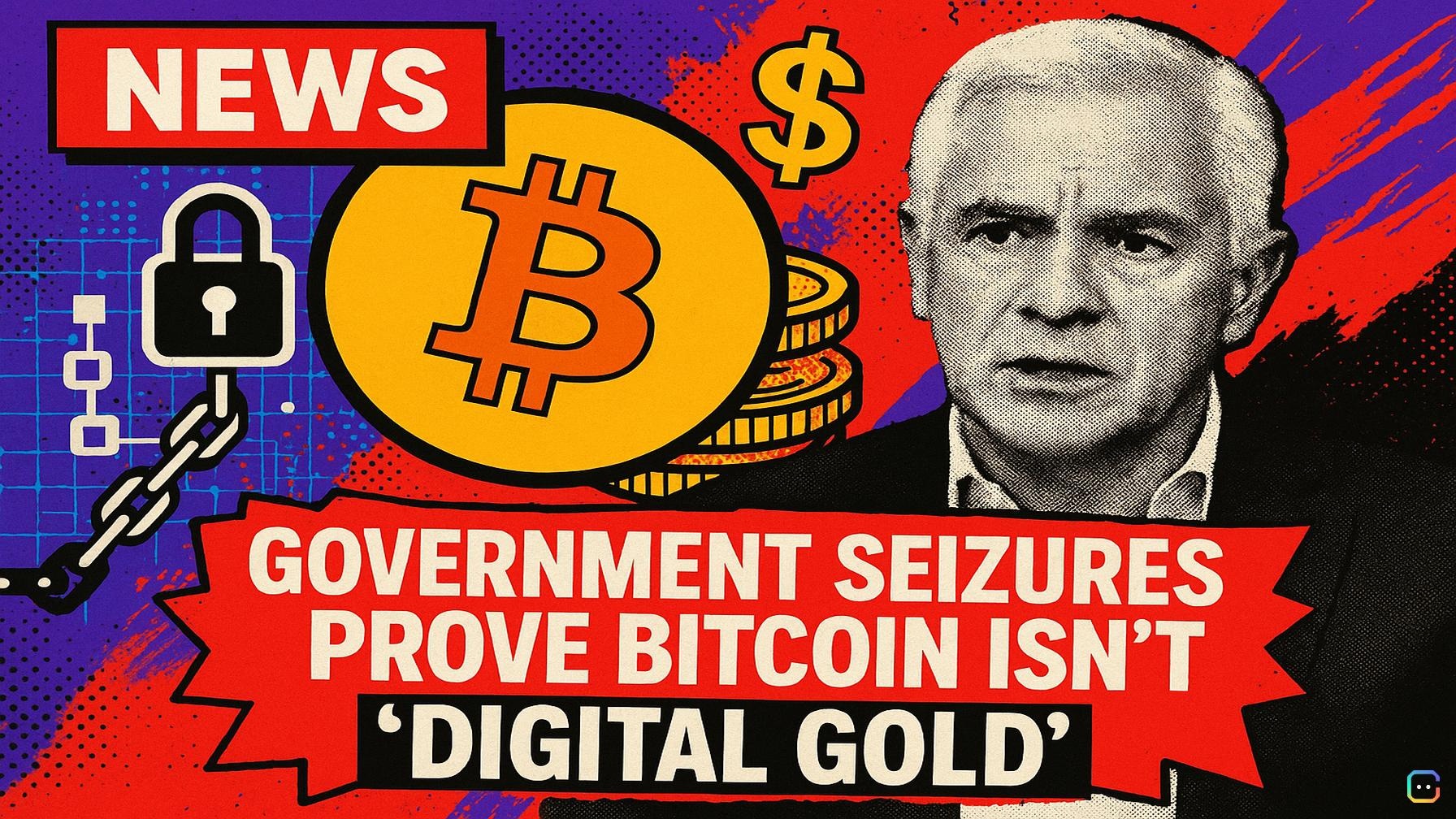
Canadian mining magnate Frank Giustra has renewed his attack on Bitcoin’s “digital gold” reputation, arguing recent government seizures show crypto remains vulnerable to tracing and confiscation.
Giustra’s comments followed remarks from U.S. Treasury Secretary Scott Bessent, who said U.S. authorities had seized nearly $1 billion in cryptocurrency tied to Iran-linked networks. Bessent warned that officials were tracking digital funds used outside traditional banking channels and even suggested some wallet owners might be unaware funds have already been taken: “Some of them are typing in their wallets right now and have no idea it’s already gone.”
Why Giustra says “not digital gold”
Giustra, a long-time gold advocate and financier in the mining sector, says blockchain transparency undermines the idea that Bitcoin can serve as a safe-haven like physical gold. He argues public ledgers make transactions traceable, exposing holders to state action—even if they avoid exchanges or memorize seed phrases. “Crypto is not safe from government seizure. That’s why it’s not digital gold,” he wrote, noting that large portions of the U.S. government’s Bitcoin reserves originate from confiscations and saying, “There is no escape,” unless a holder lives as a fugitive.
Recent enforcement and compliance examples
- U.S. authorities announced nearly $1 billion in seizures linked to Iran-related activity, part of a broader campaign against Tehran’s financial networks.
- Stablecoin issuer Tether reportedly froze $344 million in USDT across two Tron wallets connected to Iran’s Islamic Revolutionary Guard Corps after sanctions and law-enforcement action.
Those cases highlight a key distinction: stablecoin issuers can freeze tokens on request, while Bitcoin itself cannot be frozen by an issuer. Still, Bitcoin’s public transaction history can enable tracing that leads to court orders, exchange freezes, or recovery actions.
State holdings and the narrative
Giustra has repeatedly pointed to government-held Bitcoin as evidence against the “beyond-reach” narrative. Reporting estimated the U.S. government held about 328,372 BTC as of February 2026, making it the largest known state holder at the time. Giustra argues that because official reserves often come from seizures, this weakens claims that Bitcoin is immune to state control.
The other side: self-custody and control
Bitcoin proponents counter that self-custody—memorized seed phrases, hardware wallets and peer-to-peer transfers—gives users more control than bank deposits or exchange balances, limiting custodial risk. The debate centers on tradeoffs: direct control versus practical risks such as tracing, legal pressure, border enforcement, exchange surveillance and personal-security threats if authorities link individuals to specific wallets.
Why it matters
As investors hunt for assets that can hedge against fiat risk, the Bitcoin-versus-gold debate remains central. Advocates point to Bitcoin’s fixed supply and borderless transferability; gold supporters emphasize a long track record, a lack of a public digital trail and offline settlement. Giustra doesn’t deny Bitcoin’s market value—his critique is narrower: he disputes whether crypto deserves the same safe-haven status historically afforded to physical bullion.
For now, Giustra’s comments keep pressure on one of Bitcoin’s most powerful narratives: if crypto can be traced and seized, he argues, it shouldn’t be treated as “digital gold” in the same way as physical gold.
Read more AI-generated news on: undefined/news