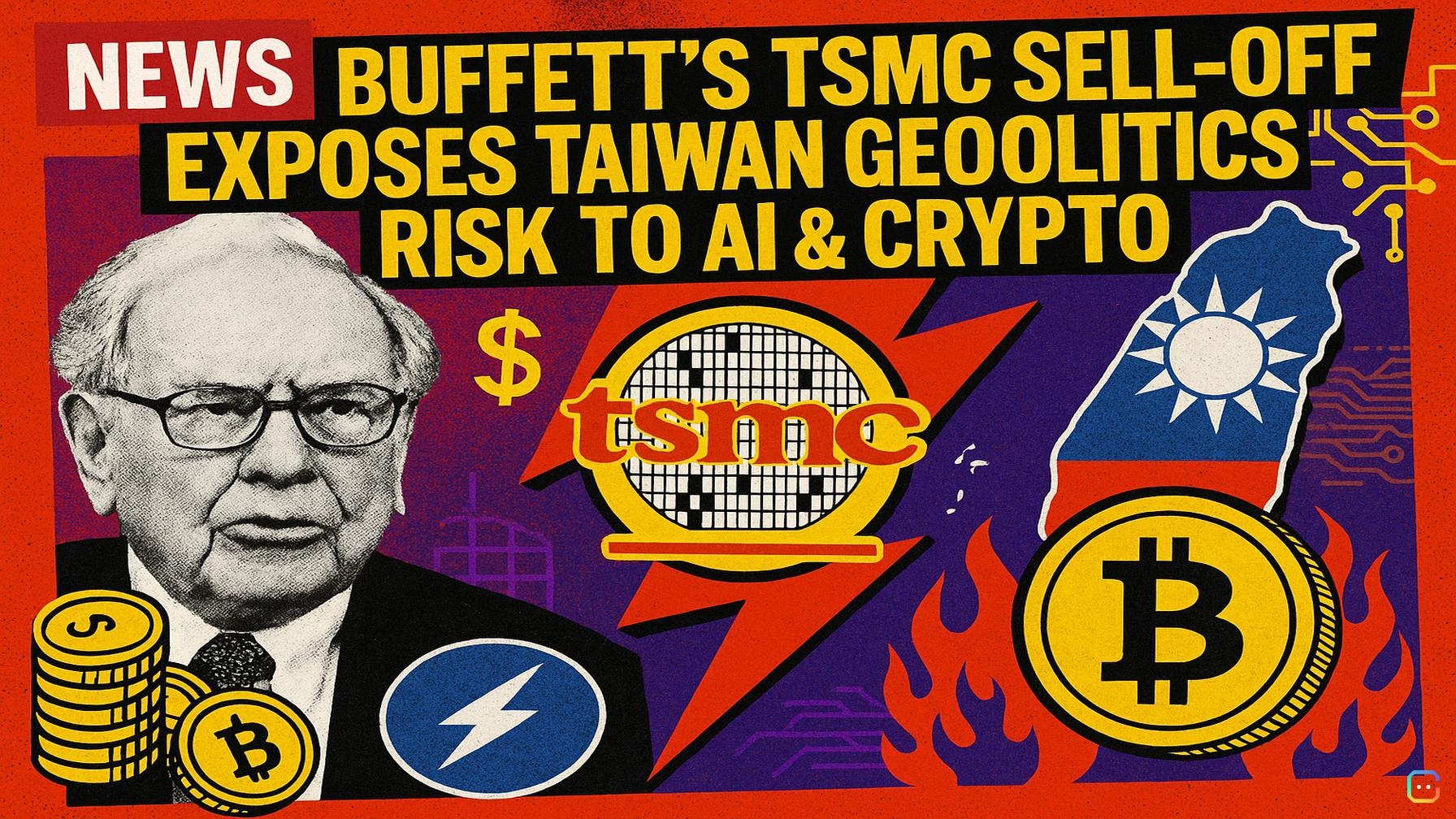
Warren Buffett’s abrupt exit from Taiwan Semiconductor Manufacturing Co. (TSMC) is a lesson in the limits of even the most admired buy-and-hold strategy — and it matters to anyone betting on the future of AI and crypto infrastructure.
Berkshire Hathaway revealed its initial TSMC stake in November 2022, saying it had accumulated roughly $4.1 billion of shares during Q3. That looked like a classic Buffett move: buying into a company with dominant margins, enormous barriers to entry, and unrivaled control of cutting‑edge chip manufacturing — the backbone of the AI revolution.
But by Q4 2022 Berkshire had sold roughly 86% of that position, and the remainder was gone by May 2023. For an investor famous for saying he buys businesses “forever,” clearing a major holding in under two quarters was striking — especially because Buffett never doubted the company’s quality. At Berkshire’s 2023 annual meeting he called TSMC “one of the best-managed companies and important companies in the world.” His reason for selling was blunt: “I don’t like its location.”
That location risk refers to rising U.S.–China tensions and the possibility of a conflict involving Taiwan. Buffett’s move was driven by geopolitical investment risk, not by doubts about TSMC’s operations or profitability. And that risk, he signaled, remains unresolved for anyone evaluating TSMC stock today.
The strategic stakes are enormous. Atreides Management CIO Gavin Baker put TSMC’s leverage over the AI supply chain in stark terms at the 2026 Sohn Conference: “If Taiwan Semi did what Jensen wanted, Nvidia could sell $2 trillion of GPUs in 2026 or 2027.” TSMC produces roughly 90% of the world’s most advanced semiconductors, carries a market value north of $2 trillion, and is the crucial foundry for Nvidia, AMD, Broadcom, Amazon, Microsoft, Alphabet and other major AI players. In effect, investors in TSMC hold a stake in the single chokepoint that determines how much advanced AI compute makes it to market.
That tension — a business case that has only strengthened versus a geopolitical risk that hasn’t disappeared — is why Buffett’s short-lived ownership still matters. The fundamentals for TSMC look better than ever. The same strategic vulnerability that prompted Berkshire’s exit, however, remains an open question for any investor weighing TSMC today.
Read more AI-generated news on: undefined/news