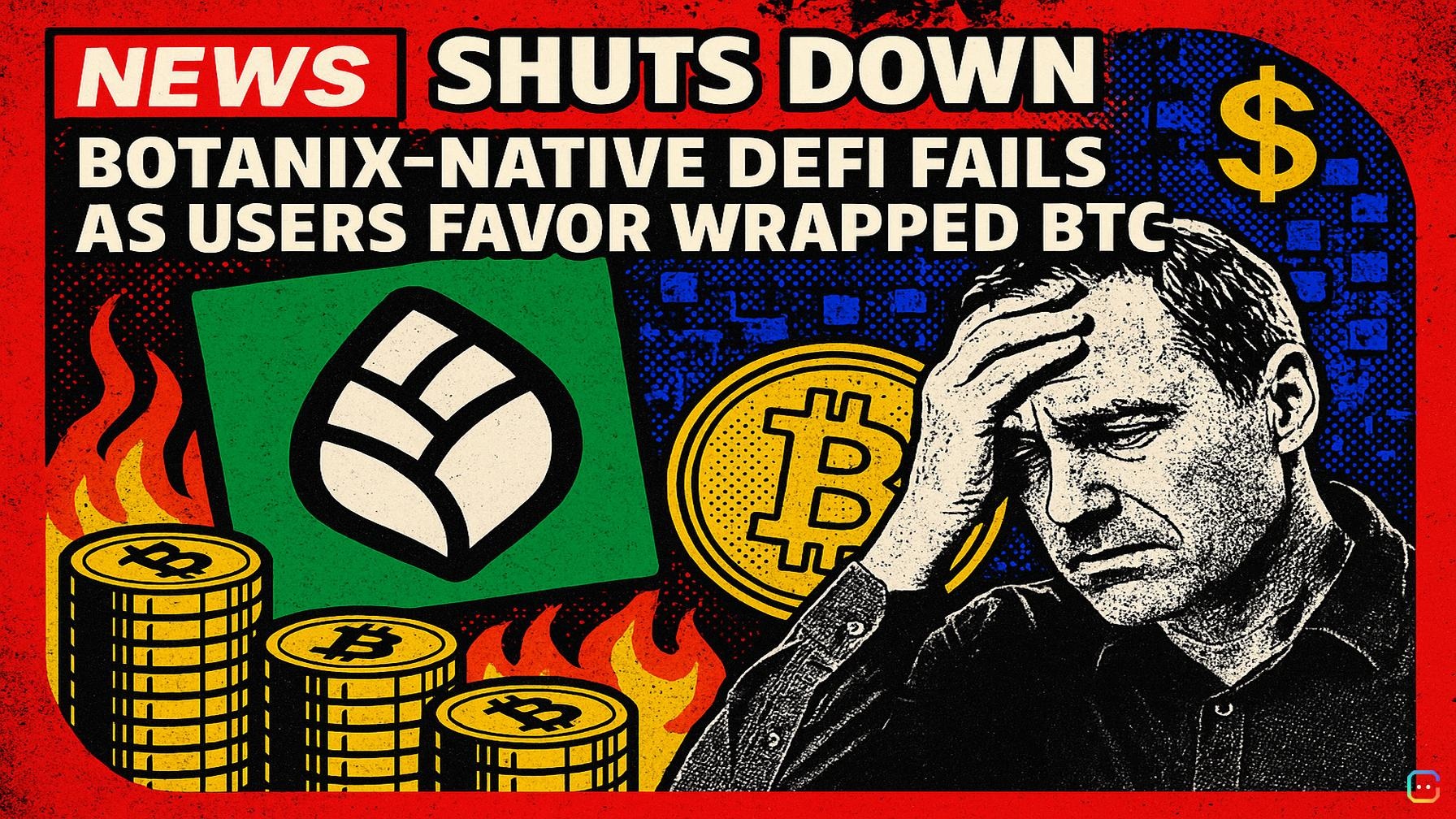
A high-profile attempt to bring full DeFi functionality to Bitcoin has quietly folded, with the team behind layer-2 network Botanix delivering a blunt post-mortem: users simply didn't care.
Botanix announced on X Tuesday that it is winding down operations roughly a year after its mainnet launch. “It did not work,” the project wrote. “At least not in this market and not in this timeline.” The team blamed weak market conditions and what it called a broader industry indifference to building richer on-chain utility directly on Bitcoin.
What Botanix tried to do
- Botanix set out to make Bitcoin “programmable” by enabling Ethereum-style smart contracts and decentralized applications to run on the Bitcoin base layer via a layer-2. The goal: let BTC holders put their coins to work — lending, trading on DEXs, staking or otherwise participating in DeFi without leaving the Bitcoin ecosystem.
- The project raised $14.4 million across two funding rounds in 2023 and 2024, but saw only $119,500 in total value locked (TVL) when it closed, according to DeFiLlama — a stark mismatch between capital raised and user traction.
Why it failed, according to the team
Botanix argued that “making Bitcoin programmable, productive and integrated into real financial activity isn't where real-world users sit right now.” The project suggested that, for most people, the combination of Bitcoin’s security and wrapped or synthetic representations of BTC on other chains has been “good enough” for yield and DeFi use cases.
A pragmatic competitor: wrapped BTC
The post-mortem points to wrapped tokens (like wBTC) as a simpler way to marry Bitcoin’s liquidity with the smart-contract functionality of chains such as Ethereum. wBTC — introduced in 2019 — and more recent institutional products from Coinbase and Circle can be used on mature L2s to access lending, yield and leveraged exposure. “Users have voted with their behaviour,” Botanix wrote, arguing that the trust assumptions of wrapped BTC on Ethereum are “acceptable to almost everyone who wants Bitcoin-denominated DeFi.”
Broader implications for Bitcoin L2s
Botanix’s shutdown raises broader questions about the viability of Bitcoin-native DeFi and other Bitcoin layer-2 projects — from Rootstock to rollups like Citrea — especially during a prolonged market lull. CoinDesk reached out to Rootstock and Citrea; neither responded by press time.
Industry voices expect more consolidation. Roshan Dharia, CEO of digital-asset investment firm Echo Base, told CoinDesk that Botanix’s collapse is symptomatic of an “over-built industry, with far more networks competing for users, developers and capital.” He predicts further wind-downs and consolidation through 2026 as activity concentrates in fewer ecosystems.
Market backdrop
The closure comes amid a rough stretch for Bitcoin — a reminder that broader price declines and investor caution can chill interest in building new utility on the network. Botanix acknowledged this reality, conceding that Bitcoin may ultimately “settle” as primarily a reserve asset, in which case demand for Bitcoin-native DeFi could remain permanently limited.
Bottom line
Botanix’s end is a candid take on the limits of Bitcoin DeFi under current conditions: even well-funded projects struggle to attract users when simpler, cross-chain workarounds satisfy demand. For builders and investors, the episode reinforces the need to weigh user behavior and trust assumptions carefully before betting on Bitcoin-native programmable finance.
Update (June 10, 12:35 UTC): Adds comment from Roshan Dharia.
Read more AI-generated news on: undefined/news