Headline: Adam Back Says “We Are All Satoshi” Tweet Was a Film Reference — Not an Admission
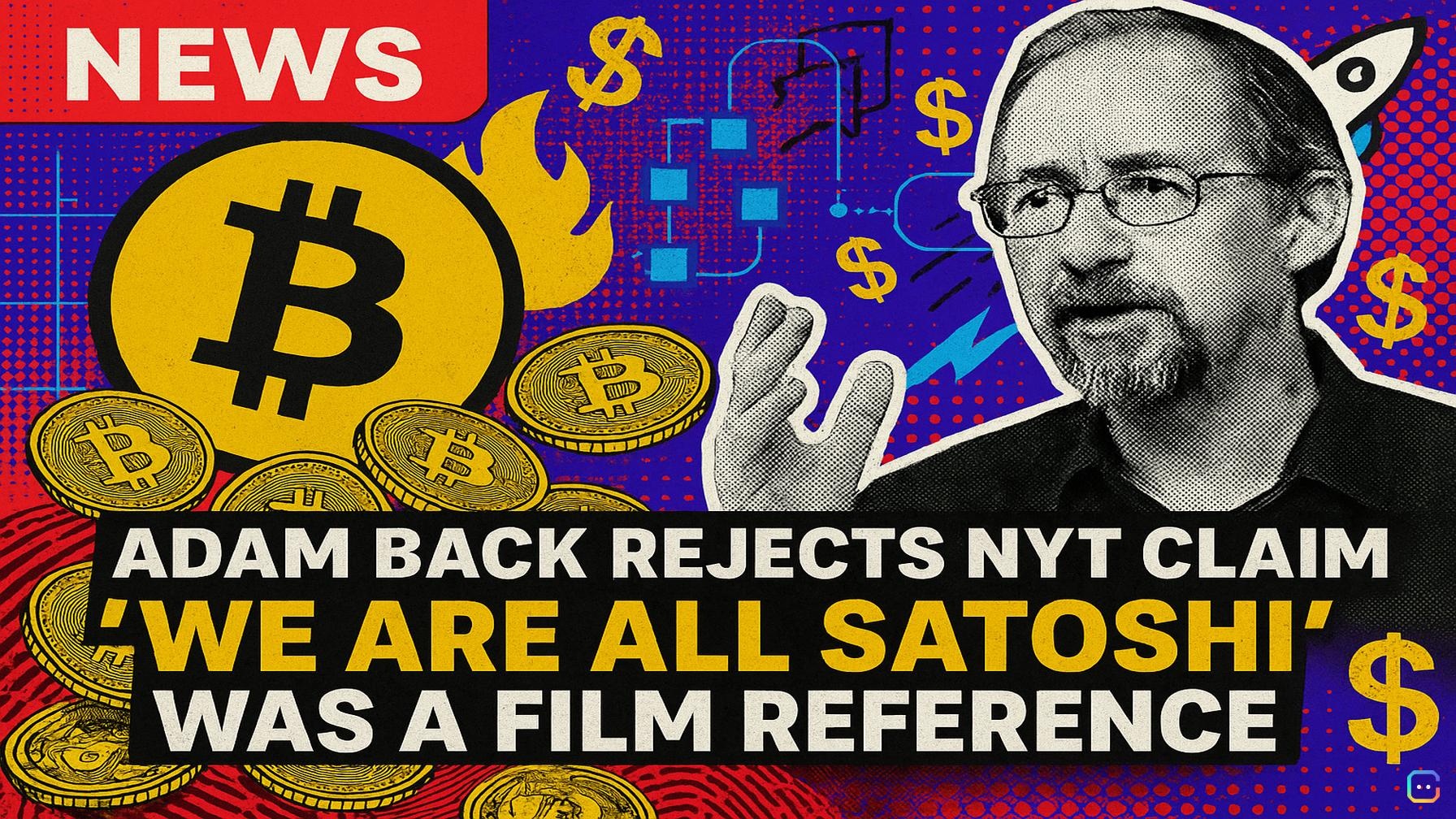
A terse three-word tweet from 2023 — “We Are All Satoshi” — briefly became one of the most dissected posts in Bitcoin history after a New York Times investigation singled out cryptographer Adam Back as a leading candidate for Bitcoin’s anonymous creator. Back now says the tweet had nothing to do with confessing authorship: it was a reference to a short film, not a hidden admission.
What the NYT reported
- On April 8, 2026 the New York Times published a year-long probe, led by journalist John Carreyrou, that analyzed more than 134,000 posts from 620 candidates on cryptography mailing lists going back to 1992. The story identified Back, a 55-year-old computer scientist living in El Salvador, as the closest linguistic match to Satoshi Nakamoto.
- The NYT’s analysis focused heavily on stylistic fingerprints. Investigators catalogued 325 hyphenation quirks in Satoshi’s writing; Back matched 67 of them, while the second-closest candidate matched 38. They also pointed to shared habits such as British spellings, consistent hyphenation, alternating use of “e-mail” and “email,” and double spacing between sentences.
- Timing was another element cited: Back was a visible participant in digital-cash forums for years, but his postings dropped off around the time Satoshi introduced Bitcoin in late 2008 — a cadence the investigators flagged as notable.
Back’s rebuttal and context
- Back pushed back on the NYT interpretation. He confirmed his long involvement in those forums but argued that a larger volume of posts naturally produces more stylistic overlap for analysts to find. In his view, many researchers were independently exploring similar ideas about digital cash, so overlapping technical language and concepts aren’t proof of a shared identity.
- On the viral three-word tweet specifically, Back said it was inspired by the short film Block 170, The First Transaction, which features the phrase carved into stone. He denied any intent to imply he was Satoshi and said he does not know who created Bitcoin.
- Beyond defending himself, Back made a broader point: the mystery around Satoshi may be beneficial. He argued that Bitcoin’s founderless status helps the network be perceived as a neutral, standalone monetary protocol rather than the project of a single individual — in other words, the anonymity is a feature, not a bug.
Why this still matters
- The NYT investigation renews public interest in Satoshi’s identity and highlights how computational linguistic methods are being used to probe authorship questions. But Back’s response underscores the limits of such analysis and the role of context, volume of writing, and convergent technical vocabulary.
- Whether or not the debate settles the question of who Satoshi is, the controversy illustrates how quickly symbolic gestures — a three-word tweet, a change in posting cadence — can be amplified in crypto’s high-stakes narrative environment.
Image credits: featured image from Blockstream, chart from TradingView.
Read more AI-generated news on: undefined/news