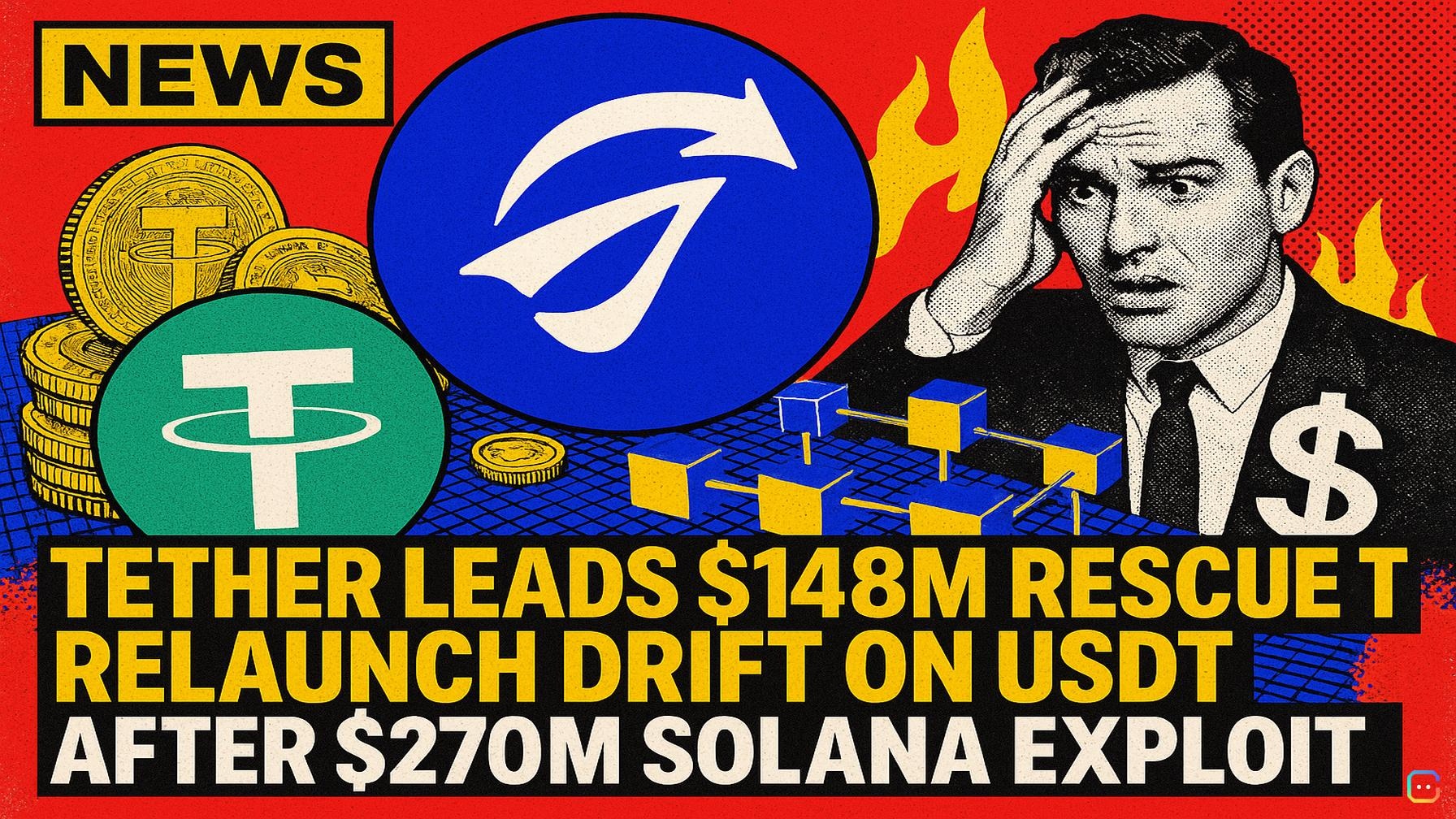
Tether leads a roughly $148M rescue package to relaunch Drift with USDT after $270M Solana exploit
Drift Protocol — the largest decentralized perpetual futures exchange on Solana — has secured a proposed funding package of up to $147.5 million (about $148 million) led by stablecoin issuer Tether as it prepares to relaunch using Tether’s USDT as its settlement layer.
The deal, announced Thursday, allocates up to $127.5 million from Tether and $20 million from other partners. The package is designed to support user recovery after a massive April 1 exploit that drained more than $270 million and to reboot Drift as a USDT-based perpetuals exchange on Solana. Until now, Drift settled trades in Circle’s USDC.
How the rescue is structured
- The financing mixes a revenue-linked credit facility, ecosystem grants and loans to designated market makers.
- A portion of Drift’s future trading revenue, together with committed capital from the package, will flow into a recovery pool. That pool is intended to make good on roughly $295 million in user losses over time.
- Tether also plans to finance fee reductions, user incentives tied to the USDT migration and liquidity support to improve market depth at relaunch.
Background: the exploit and aftermath
Drift’s April 1 hack — attributed to a North Korea-linked group that reportedly posed as a quantitative trading firm for about six months — siphoned off more than $270 million from the platform. The attacker moved around $232 million in USDC from Solana to Ethereum using Circle’s cross-chain transfer protocol. In the wake of the incident, Drift’s governance token, DRIFT, plunged roughly 70%.
Circle drew criticism from parts of the crypto community after the attacker moved funds across chains. Investigators and commentators argued Circle could have acted faster to blacklist wallets or freeze funds; Circle’s position, articulated by CEO Jeremy Allaire, is that it only freezes USDC wallets when directed by law enforcement or courts, citing legal risks. By contrast, Tether has a track record of more actively freezing assets linked to hacks or illicit activity.
Why this matters for stablecoins and Solana DeFi
- The deal pushes USDT deeper into Solana’s trading infrastructure, signaling Tether’s continued appetite to expand its footprint in decentralized derivatives.
- It highlights divergent approaches among major stablecoin issuers: Circle’s rules-bound, regulator-aligned strategy versus Tether’s operational flexibility around freezing funds.
- Competition among stablecoins remains intense. CoinDesk data puts USDT supply at roughly $185.5 billion versus about $78.6 billion for USDC, though Circle has recently seen transaction volumes rise as USDC’s market share expands.
About Drift
Founded in 2021, Drift is Solana’s largest decentralized perpetual futures exchange, with more than 175,000 users and roughly $150 billion in cumulative trading volume. The platform offers perpetual futures, spot trading, lending, borrowing and cross-margin trading.
Next steps
Drift says the funding package provides a pathway to restore user funds and resume operations on a USDT-native footing. The proposed financing is meant to stabilize liquidity and trading activity at relaunch while channeling revenue and capital toward compensating affected users over time.
Read more: How a Solana feature designed for convenience let attackers drain more than $270 million from Drift.
Read more AI-generated news on: undefined/news