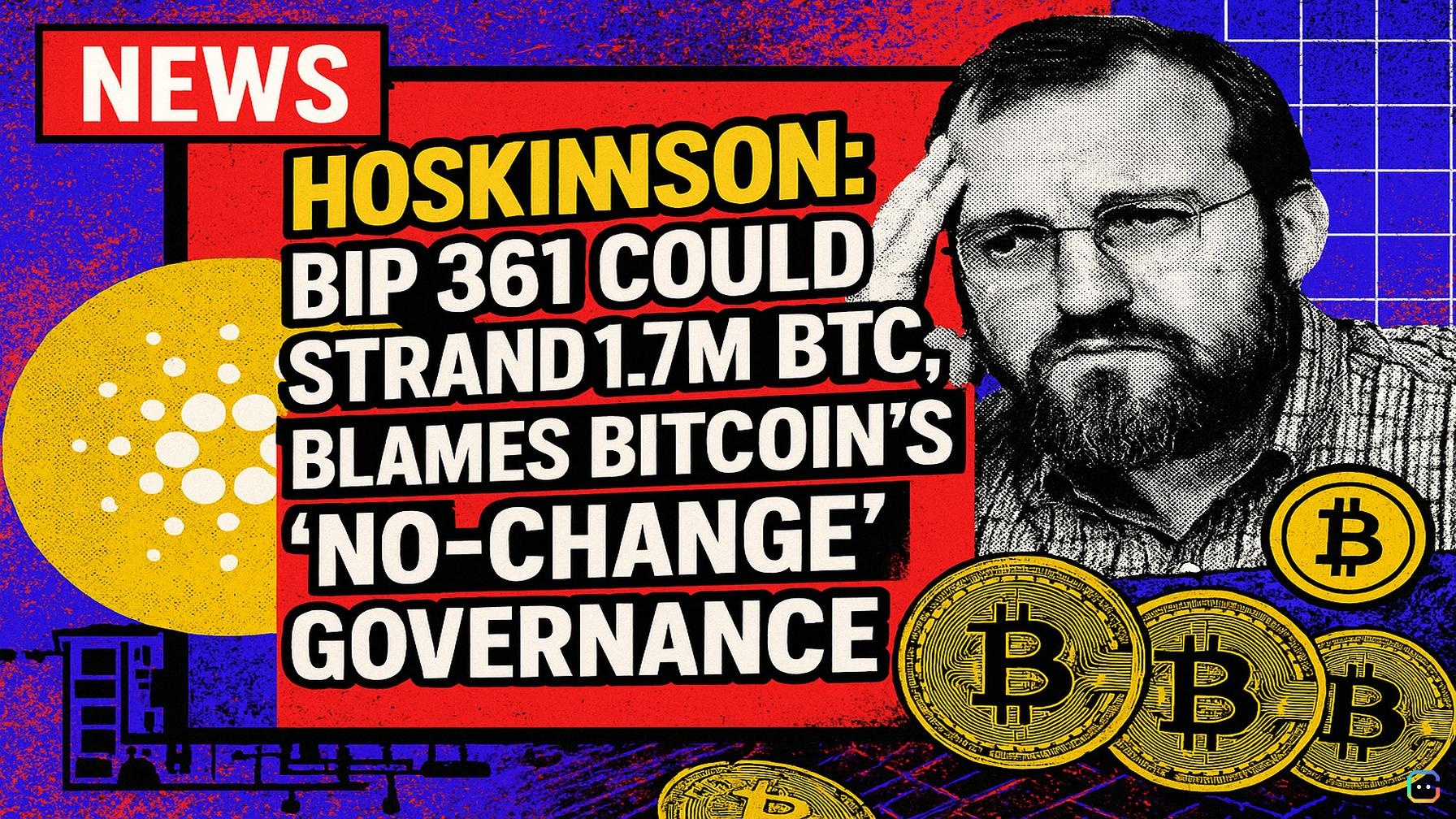
Charles Hoskinson, Cardano’s founder, used one of his most provocative livestreams in recent memory to pin blame for a growing quantum-computing headache on Bitcoin’s governance culture — not just its cryptography.
In a video titled “BIP 361: Welcome to ShitcoinLand, Bitcoin,” Hoskinson framed the BIP 361 debate as an acknowledgment that quantum risk has moved from theory to an actionable threat. He pointed to language in the proposal noting that, as of March 1, 2026, more than 34% of all Bitcoin had revealed public keys on-chain — leaving those UTXOs theoretically vulnerable to theft by a sufficiently powerful quantum computer. That 34% equates to roughly 8 million BTC, the proposal and Hoskinson say.
What BIP 361 would do, its authors propose, is force a migration: any bitcoin that doesn’t move to a “quantum-safe” address within five years of activation would be frozen by consensus. Hoskinson’s critique centers on two related claims: first, he says that the plan effectively requires a hard fork, even if it is framed differently. Second, he insists that the forced migration idea will strand a swath of older coins that cannot be recovered by the proposed proof systems.
Hoskinson argues those stranded UTXOs are substantial. He claimed about 1.7 million BTC would be effectively unspendable under BIP 361’s recovery approach — including approximately 1.1 million BTC he attributed to Satoshi Nakamoto’s early addresses — because those coins predate the wallet standards and seed-phrase schemes the recovery logic assumes. He was blunt: recovery-by-seed is not a universal fix, he says, and the proposal’s assurances to the contrary amount to “a lie.”
Beyond technical objections, Hoskinson broadened his critique into a cultural indictment of Bitcoin maximalism. He argued that a doctrine of “Bitcoin never changes” has left the ecosystem ill-equipped to coordinate the kind of sweeping protocol decisions that a quantum risk mitigation might require. “If they don’t do this, that money will be stolen in the 2030s,” he conceded about the intent behind BIP 361 — but he emphasized the dilemma: either accept theft risk for legacy coins or impose a migration that reads like confiscation for many holders.
As a contrast, Hoskinson pointed to projects with formal on-chain governance — Cardano, Polkadot and Ethereum — saying such mechanisms at least provide a transparent forum for resolving upgrade disputes and trade-offs. “If you had onchain governance, you could solve it,” he argued.
Hoskinson explicitly treats the quantum threat as real and potentially severe; his critique is aimed at how Bitcoin’s social and governance structures would handle a response. At press time, Cardano (ADA) traded at $0.2499.
Read more AI-generated news on: undefined/news