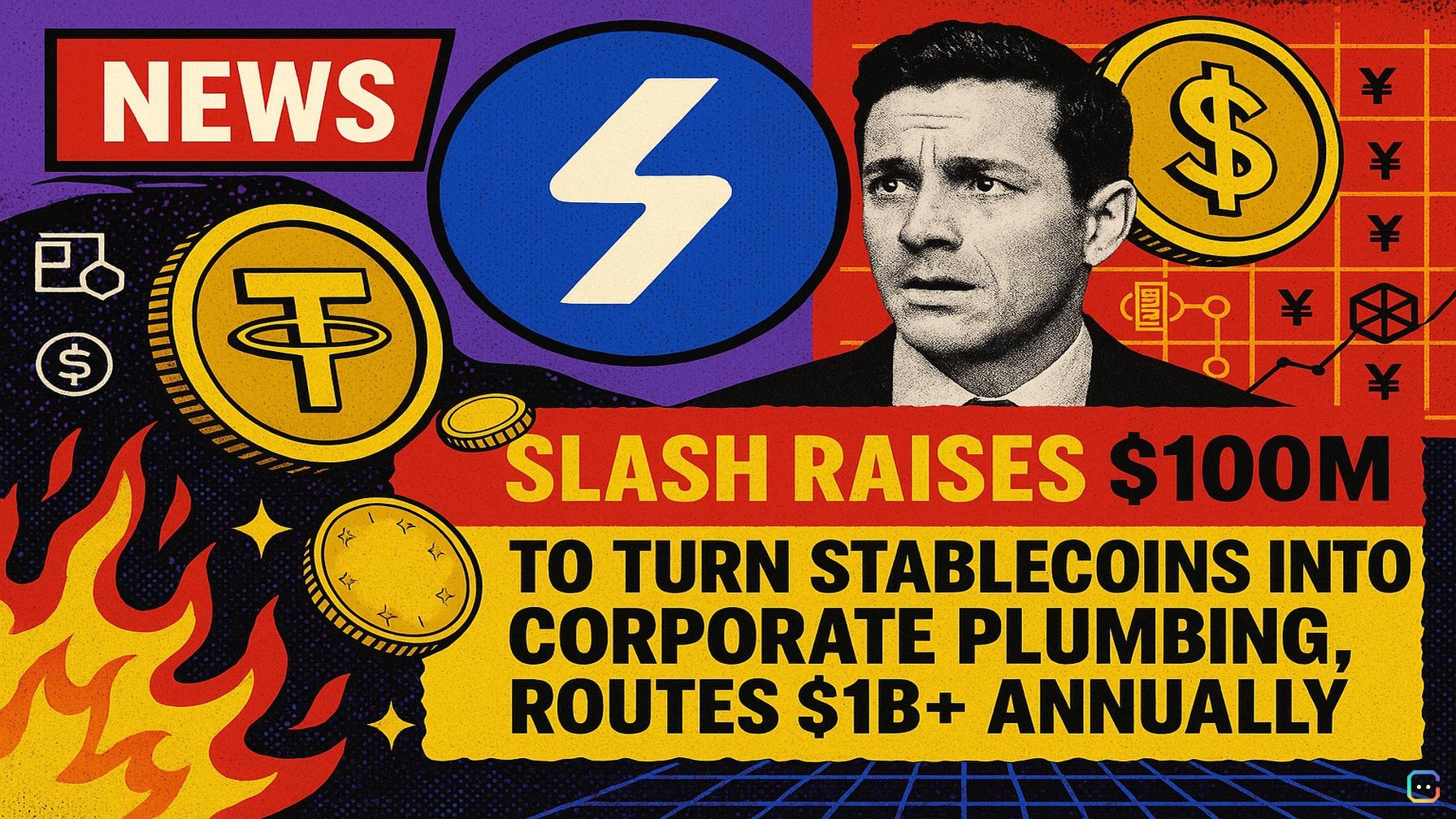
Slash quietly turned stablecoins into corporate plumbing — and just raised $100M to scale it.
Slash Financial, a business banking platform for online-first companies, closed a $100 million Series C at roughly a $1.4 billion valuation, led by Ribbit Capital with participation from Khosla Ventures and Goodwater Capital. Existing backers New Enterprise Associates and Y Combinator also joined, marking their fourth investment into the company.
What’s driving the round is traction: Slash now serves more than 5,000 corporate clients — from startups to larger online merchants — and says it’s routing north of $1 billion in annualized stablecoin payments just nine months after turning on USDC and USDT support. The team has an audacious target of $1 trillion in cumulative stablecoin payments by 2030.
Slash positions itself as a “financial command center” for businesses: a single dashboard to manage bank accounts, cards, payouts and blockchain rails. Features include multi‑currency accounts, virtual cards, expense management and real‑time local payments. Its stablecoin payments product lets customers send and receive USDC and USDT directly from a Slash business account “with no crypto wallets, no exchange accounts, no need to hold funds in stablecoins,” effectively hiding blockchain complexity behind a familiar treasury interface.
That shift reflects a larger industry trend: stablecoins are migrating from retail and DeFi experiments into boring but lucrative B2B plumbing — treasury, payouts and cross‑border settlement. Fintechs increasingly use stablecoins to speed settlement while keeping end users in traditional cash balances, relying on partners like Circle, Transak or banks to bridge fiat and on‑chain rails.
Big players are already buying into this thesis. In 2025 Ripple acquired Toronto’s Rail for $200 million, arguing stablecoin rails are becoming the backbone of cross‑border treasury and merchant settlement. Layer‑2 projects and custody firms are also pairing up to “supercharge institutional stablecoin flows,” with programs aimed at treasury desks and payroll teams rather than retail traders.
Slash now finds itself competing with incumbents such as Ramp and Brex and with crypto‑native payment stacks that embed stablecoins beneath the surface. For investors like Ribbit and Khosla, the bet is straightforward: the repetitive, low‑glamour work of wiring dollars and stablecoins through corporate back offices promises steadier economics than speculative yield plays — and whoever owns these rails could own much of the next decade’s crypto payments infrastructure.
Read more AI-generated news on: undefined/news