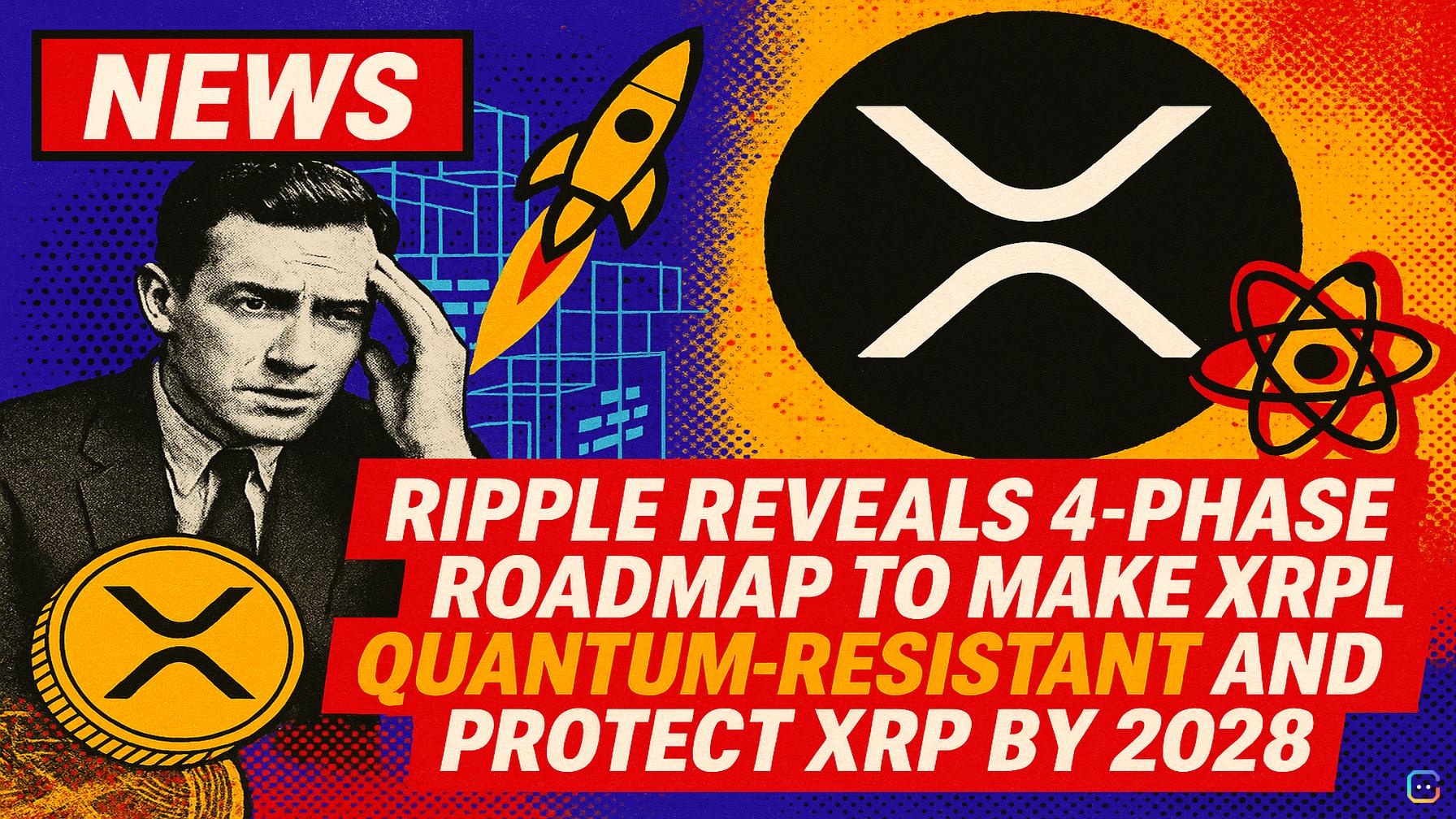
Ripple has laid out a four-phase roadmap to make the XRP Ledger (XRPL) quantum-resistant by 2028, aiming to shield the layer-1 blockchain and its native token XRP from future quantum attacks.
Why this matters
Quantum computing remains an emerging threat, but recent warnings have accelerated planning across the industry. Google recently suggested a quantum machine could threaten Bitcoin with less power than previously thought, and some analysts have pegged 2029 as a speculative “Q‑day” deadline to have defenses in place. Ripple’s timeline targets readiness a year earlier.
What’s at risk
Ripple highlights three core vulnerabilities that quantum computers would exploit on XRPL (and most blockchains):
- Public keys get exposed on-chain when accounts sign transactions. A powerful quantum machine could potentially reverse-engineer the private key from that public key and drain funds.
- Accounts that have held funds for long periods are especially exposed: the longer a public key sits on-chain, the more time an attacker has to target it.
- Fixing this is not just a technical task — it’s an operational one, because changes affect every XRPL holder and every app built on the ledger.
The four-phase plan
Phase 1 — Q-Day readiness (emergency mode)
- Aimed as an emergency safety valve if quantum capabilities arrive unexpectedly fast.
- Would implement a “hard shift”: classical public-key signatures would be disallowed, forcing migration of funds to quantum-safe accounts.
- Includes work on zero-knowledge proof-based recovery methods so account owners can prove ownership and move funds even in compromised scenarios.
Phase 2 — Full vulnerability assessment (underway; target H1 2026)
- Ripple’s cryptography team will conduct a network-wide assessment of quantum risk and test post-quantum defenses recommended by NIST.
- The team is weighing trade-offs: post-quantum algorithms typically use larger keys and signatures, which can increase ledger load.
- To accelerate testing, Ripple has partnered with quantum security firm Project Eleven for validator-level tests, network benchmarking, and early custody wallet prototypes.
Phase 3 — Controlled integration and developer testing (target H2 2026)
- Post-quantum signatures will be introduced alongside existing schemes on XRPL’s developer test network, letting developers build and validate without disrupting the live ledger.
- Ripple will also reassess broader cryptography for privacy and compliant tokenization features (e.g., confidential transfers), focusing on solutions that scale across XRPL.
Phase 4 — Full deployment (target 2028)
- Transition from experimentation to production: Ripple plans to design and propose a formal XRPL amendment to adopt native post-quantum cryptography and begin large-scale migration to PQC-based signatures.
What this means for users and the ecosystem
Ripple’s staged approach aims to make migration orderly and minimize disruption. By combining emergency readiness, thorough testing, developer rollout, and a phased network upgrade, the company is positioning XRPL to withstand future quantum threats while balancing performance and operational realities.
Contextually, Ripple’s plan joins a broader industry push—Bitcoin developers and others are already exploring mitigations—underscoring that quantum resistance is moving from theoretical concern to coordinated engineering effort.
Read more AI-generated news on: undefined/news