ALCUM’s xCUP: not a warehouse token, but a working industrial yield play on recycled copper
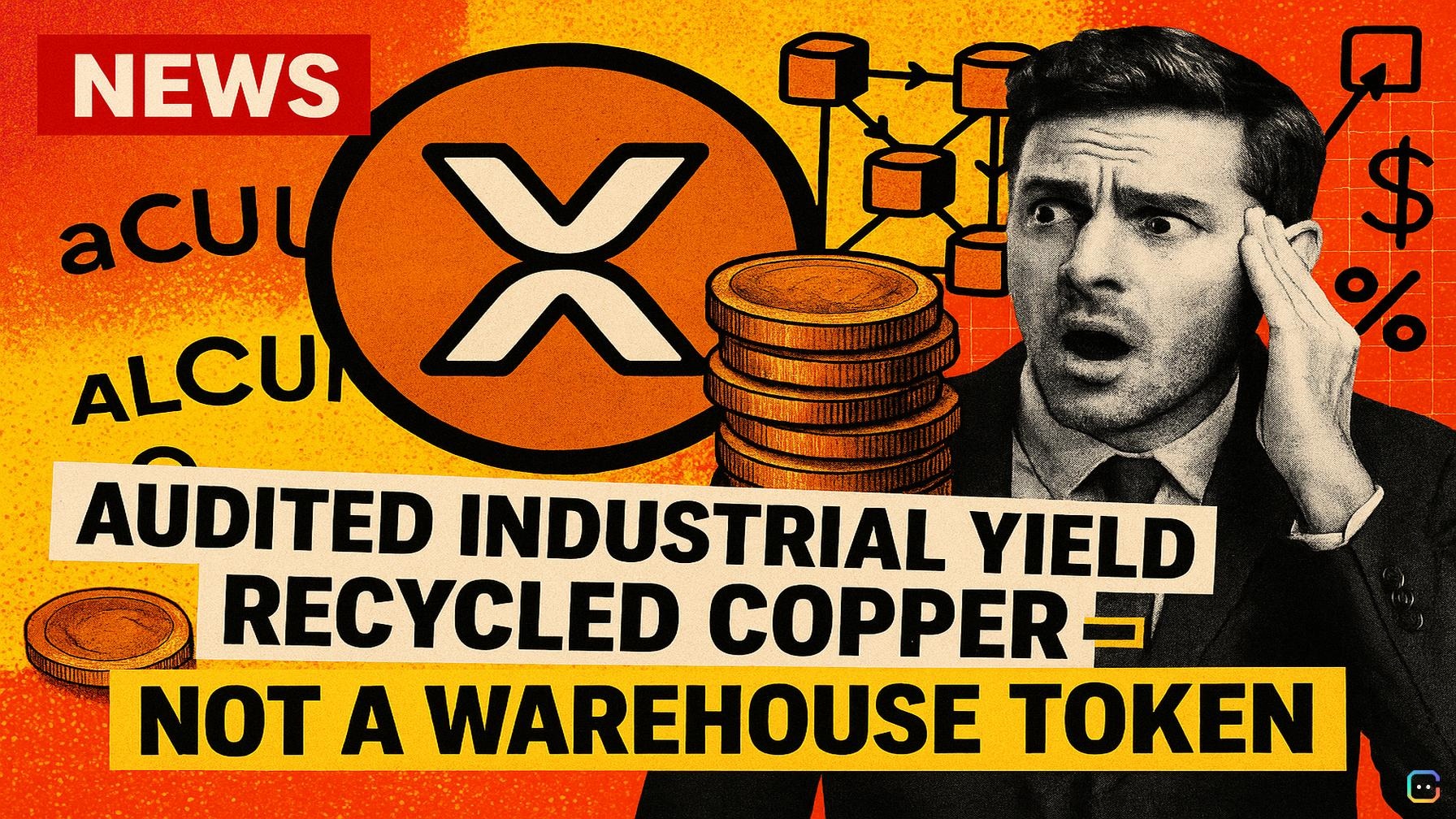
In a conversation with crypto.news, Vytautas Mackonis, founder of Swiss-based ALCUM, framed xCUP as a corrective to the common “tokenized commodity” playbook. Rather than issuing a digital IOU on a metal bar sitting in storage, xCUP tokenizes a 30‑day, hedged industrial recycling cycle so USDC allocators earn audited processing margins — not speculative exposure to copper’s spot price.
“xCUP is not a storage token. It is a yield instrument backed by an active industrial cycle,” Mackonis says. Where most tokenized commodity products deliver static exposure to a warehouse asset (your return coming only from price appreciation), ALCUM’s model turns copper into working capital: it buys secondary copper, processes it, and sells it into verified European industrial supply chains in each epoch.
How the model works (in plain terms)
- Epochs: Investor capital (USDC) is deployed in roughly 30‑day cycles.
- FX and procurement: USDC is converted to euros and used to buy recycled copper from the secondary market.
- Processing: Material is processed through certified industrial partners.
- Sale and yield: Finished copper is sold to verified buyers; investors receive the operational margin generated by that cycle.
Structurally, that makes xCUP feel more like trade finance or industrial private credit than a copper ETP. “The holder is not speculating on where copper trades tomorrow,” Mackonis explains. “They are participating in the operational margin of an industrial business that buys raw material, adds value through processing, and sells a finished product.”
Why recycled copper?
ALCUM’s near-term thesis emphasizes recycled copper because it carries a cost advantage over primary smelted copper and tends to exhibit relatively stable processing spreads. European industrial demand is consistent, and when you control sourcing and processing relationships, the recycling supply chain can deliver predictable, repeatable cycle economics — less correlated with short‑term spot volatility than many expect.
Risk controls and audit stack
Mackonis highlights four foundational pillars: regulated Swiss issuance, physical commodity backing, independent third‑party verification, and a yield mechanism tied to operational output (not market price moves). To manage key risks — feedstock supply and quality, copper price swings, counterparty concentration, and smart contract vulnerabilities — ALCUM layers operational and audit safeguards:
- Hedging: Processing economics are hedged via StoneX Group.
- Industrial partners: Procured and processed through audited partners such as Mirada Levante S.L.
- Physical inspections: SGS verifies weight, grade and custody at epoch boundaries.
- On‑chain transparency: NAV inputs and epoch results are recorded on‑chain; Chainlink LME price feeds are used for reference pricing.
- Smart contract security: Halborn audited the contracts (zero critical or high findings; all medium and low findings remediated pre‑deployment).
- Independent reconciliation: Accountable runs a parallel, zero‑knowledge–reconciled verification of procurement, processing and sales documentation within 30 days of each epoch close.
A practical checklist for institutional allocators
Mackonis says serious allocators should be able to validate every step. He suggests confirming:
- Physical inspection reports reference specific registered warehouse addresses and lot numbers.
- The EpochRevenue transaction timestamp on Etherscan matches the published epoch report.
- The Chainlink price feed address used by the CopperPriceConsumer contract.
- The Halborn audit report (zero critical/high findings, remediation of medium/low issues).
- Accountable’s independent verification report for the relevant epoch.
All contract addresses are published in ALCUM’s GitHub repository.
Roadmap and bigger picture
Copper is the inaugural use case, chosen for its clear industrial supply chain and long‑term demand drivers tied to grids, EVs and the energy transition. But Mackonis stresses the architecture is modular and replicable: the goal is to prove a template that meets institutional due‑diligence standards and delivers verifiable, audited yield from real‑world operations. If that credibility is established with copper, the same structure could be applied to other industrial assets and commodity cycles where recycled or secondary markets and processing margins make sense.
The takeaway
xCUP reframes tokenized commodities from passive storage claims into active, auditable industrial finance. For allocators seeking yield that’s tied to operational output — backed by on‑chain transparency and a traditional audit stack — ALCUM is pitching a middle ground between crypto-native asset structures and real‑world trade finance. Whether institutional investors buy that bridge will depend on how well the model proves itself across epochs and how reliably the on‑ and off‑chain verifications line up.
Read more AI-generated news on: undefined/news