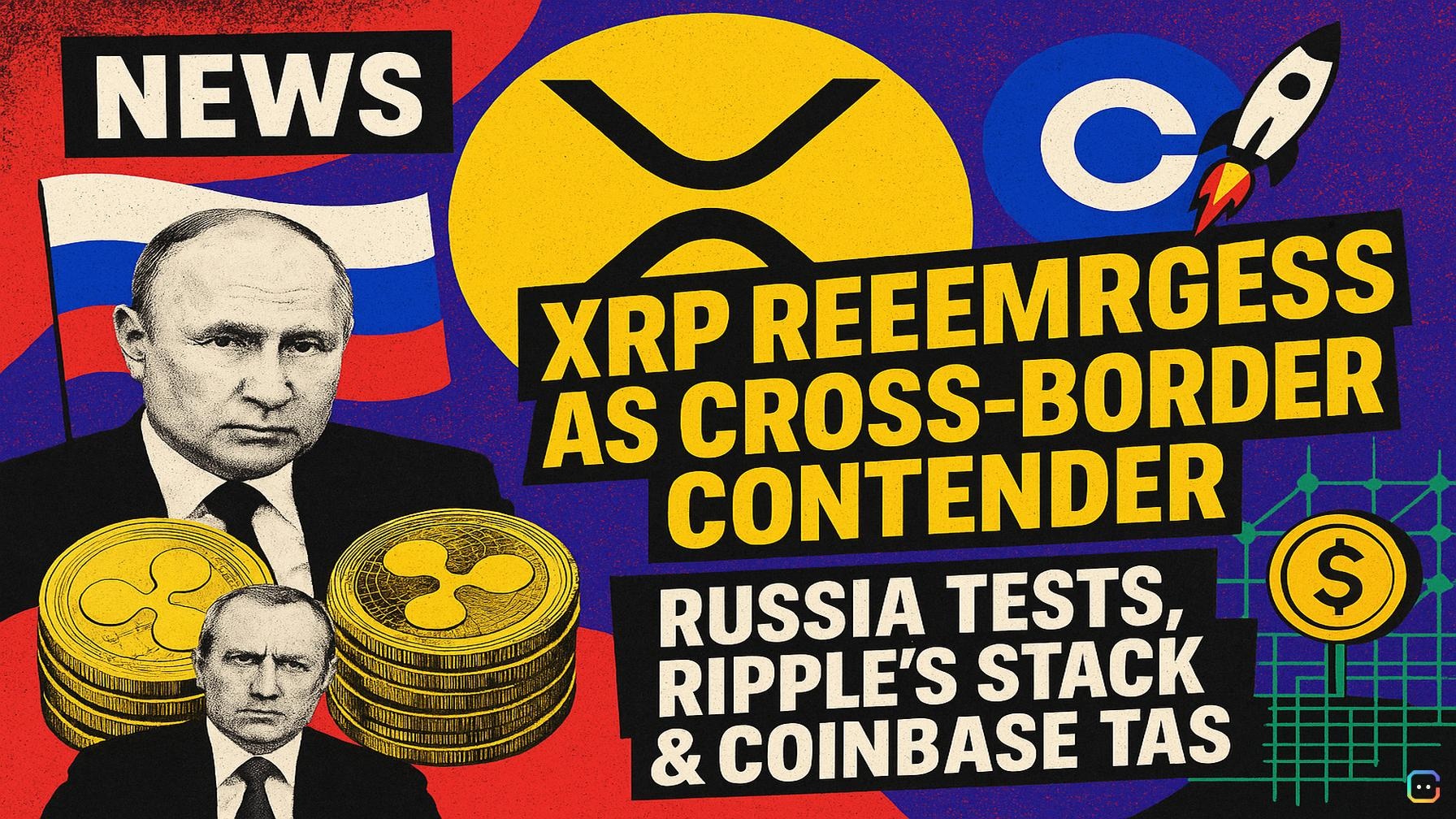
As pressure builds on global payments to get faster, cheaper and less dependent on legacy intermediaries, blockchain-based options are back in the spotlight — and XRP is attracting renewed attention. Recent reporting about early experiments in Russia, plus growing institutional interest and moves by Ripple to build an end-to-end financial stack, have put the token and its technology back into the conversation about the future of cross-border payments.
Russia’s early testing and academic interest
- Market commentator SMQKE on X revealed that in 2018 the Bank of Russia ran a test on the Ripple platform at its Novosibirsk innovation laboratory, evaluating Ripple’s suitability for cross-border settlements. Observers say the results indicate the technology could underpin a payments system if organizational, legal and technical obstacles are resolved.
- Academic work has also examined XRP’s potential role. A 2020 paper from Southern Federal University, presented at the FETDE 2020 conference, looked at blockchain adoption in Russia and highlighted XRP as a possible bridge currency for payments, even referencing Ripple’s spam-protection mechanism as part of its analysis.
Institutional signals: JPMorgan and beyond
- Institutional circles have taken notice too. A JPMorgan Chase report — reportedly shared exclusively with Mihail Turlakov at Sterbank of Russia — cited Ripple for advantages in speed, low cost and liquidity, framing XRP as a compelling asset for scaled financial use and a potential disruptor of traditional cross-border rails.
Ripple’s vertical-integration strategy
- CoinDesk coverage has traced a strategic pivot at Ripple toward vertical integration across custody, liquidity and settlement. BankXRP outlined a series of 2025 acquisitions — including Hidden Road (prime brokerage), GTreasury (treasury management) and Rail (stablecoin payments infrastructure) — that would let Ripple control more of the full institutional stack.
- That integration is designed to support RLUSD, Ripple’s stablecoin aimed at near-instant cross-border payments with fewer intermediaries than correspondent banking. CoinDesk’s Data report — commissioned by Ripple — frames this as a shift toward being an institutional financial-stack provider rather than just a payments company.
Institutional execution tools arrive
- Execution infrastructure is following suit: Coinbase plans to launch a Trade at Settlement (TAS) feature for XRP futures on May 1, 2026. TAS lets institutions execute block trades at the official settlement price, shielding them from intraday volatility — a meaningful upgrade for regulated, large-scale participants.
Why it matters
Together, these threads — central bank experiments, academic backing, institutional reports, strategic acquisitions and new trading tools — paint a picture of XRP being positioned for broader institutional use in cross-border liquidity and settlement. Significant hurdles remain (regulatory clarity, legal frameworks, and integration with existing financial plumbing), but Ripple’s recent moves and growing institutional tooling make XRP an asset to watch as payments systems evolve.
What to watch next
- Any follow-up disclosure from the Bank of Russia or Russian regulators about Ripple tests.
- Regulatory developments affecting XRP across major markets.
- RLUSD rollouts and how Ripple integrates custody, liquidity and settlement through its acquisitions.
- Uptake of Coinbase’s TAS for XRP futures and other institutional trading innovations.
Read more AI-generated news on: undefined/news