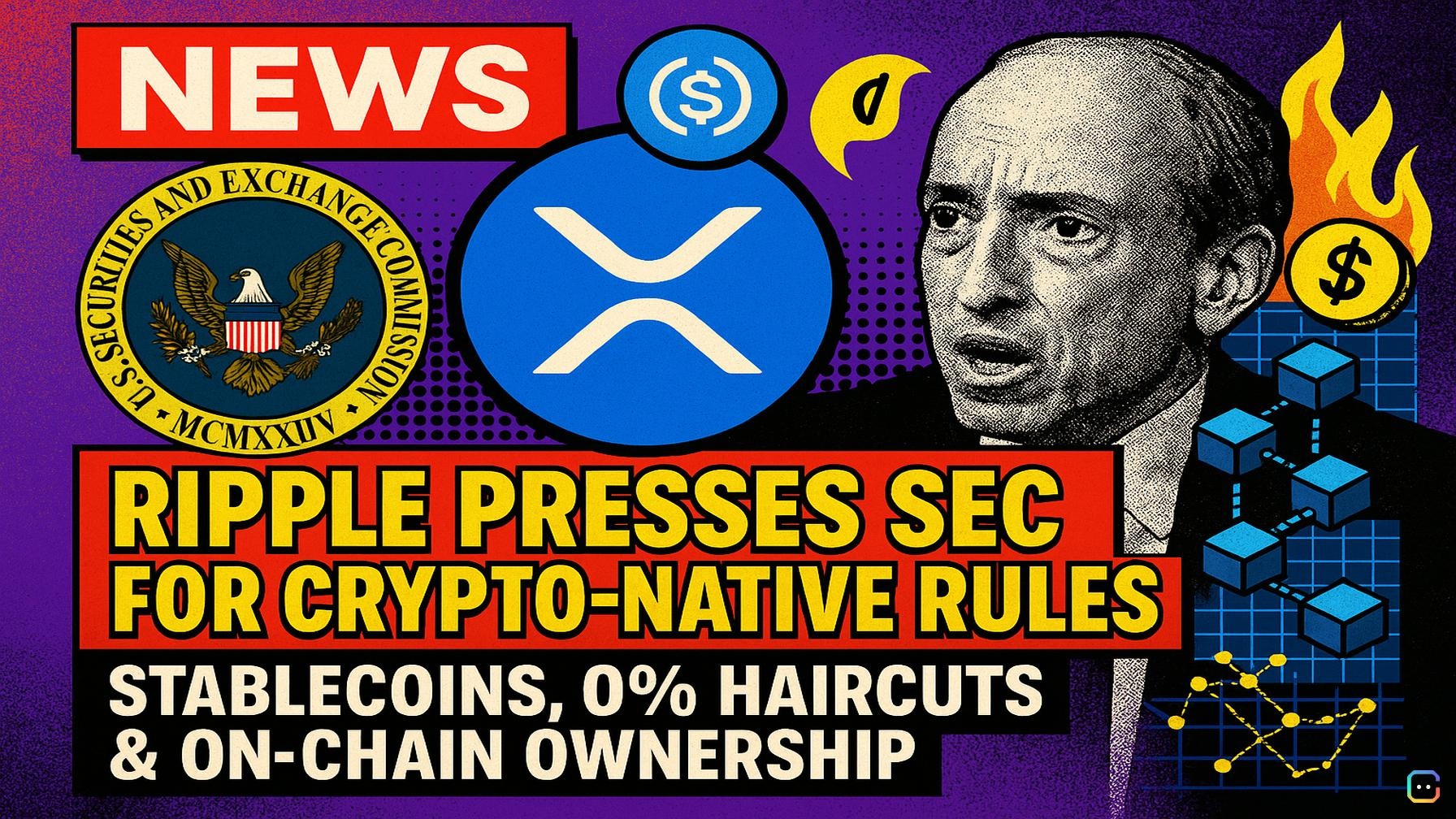
Ripple has taken another shot across the SEC’s bow — submitting a detailed follow-up letter to the SEC Crypto Task Force that presses for clearer, more crypto-native rules on stablecoins, non-security crypto assets and tokenized securities.
The letter, dated May 22, 2026 and shared publicly by XRP community account BankXRP on X on May 27, is presented as a follow-up to a March 20, 2026 meeting between Ripple and the Task Force. Ripple says the filing responds to questions raised in that meeting and lays out a set of specific regulatory changes it believes are needed to make tokenized markets workable for regulated intermediaries.
Key asks from Ripple
- Amend Rule 15c3-1 (net capital) to specify how stablecoins may be counted as collateral on broker-dealer balance sheets, so tokenized activities aren’t rendered uneconomic by capital treatment.
- Amend Rule 15c3-3 (customer protection) to create a new category called “Qualified Payment Stablecoins,” clarifying custody obligations for client stablecoins used in payments and settlement.
- Confirm that crypto assets deemed non-securities beyond Bitcoin and Ether can receive equivalent regulatory treatment when they meet liquidity/readily marketable standards — including revising Question 4 in the SEC’s FAQ on crypto asset activities.
- Reduce stablecoin haircuts — arguing a 2% haircut is “punitive” and proposing a 0% haircut where a mint-burn relationship exists between broker-dealer and issuer (BankXRP framed this as a demand that RLUSD receive a 0% haircut).
- Resolve ownership ambiguity for tokenized assets by designating an on-chain registry as the single authoritative legal register, eliminating “dual-registry ambiguity” in digital-twin structures.
Why it matters
Ripple’s requests target three technical but consequential areas: net capital treatment (which drives how much capital firms must hold against positions), customer protection/custody rules (which affect how client tokens are safeguarded), and legal certainty over ownership of tokenized assets. Clarifying those rules would lower operational and capital costs for broker-dealers handling tokenized instruments and could accelerate adoption of on-chain settlement and tokenized securities.
The push to treat non-security crypto assets beyond BTC and ETH similarly matters because, under current public guidance, Bitcoin and Ether are often singled out as “safe” for certain favorable treatments. Ripple wants the SEC to make that pathway available to other assets that demonstrably meet liquidity and regulatory tests — a change that would be significant for issuers, exchanges and intermediaries arguing for parity.
Tone and reaction
BankXRP’s social post summarized the filing bluntly — stablecoins as proper collateral, RLUSD at 0% haircut, parity for XRP and other non-securities with BTC/ETH, and recognition of on-chain registries as the sole legal record — and concluded, “Ripple isn’t asking anymore. They’re telling.” The visible page of Ripple’s submitted letter does not explicitly name XRP in the section on non-securities, but the implication is clear for assets that market participants believe are non-securities and sufficiently liquid.
Market snapshot
At press time, XRP was trading around $1.3299.
Bottom line
Ripple’s follow-up letter is a direct push for modernized, crypto-native interpretations of long-standing broker-dealer rules. If the SEC engages with these proposals, the outcome could reshape how stablecoins and tokenized assets are treated across regulated markets — affecting custodians, exchanges, issuers and institutional participants preparing for on-chain settlement at scale.
Read more AI-generated news on: undefined/news