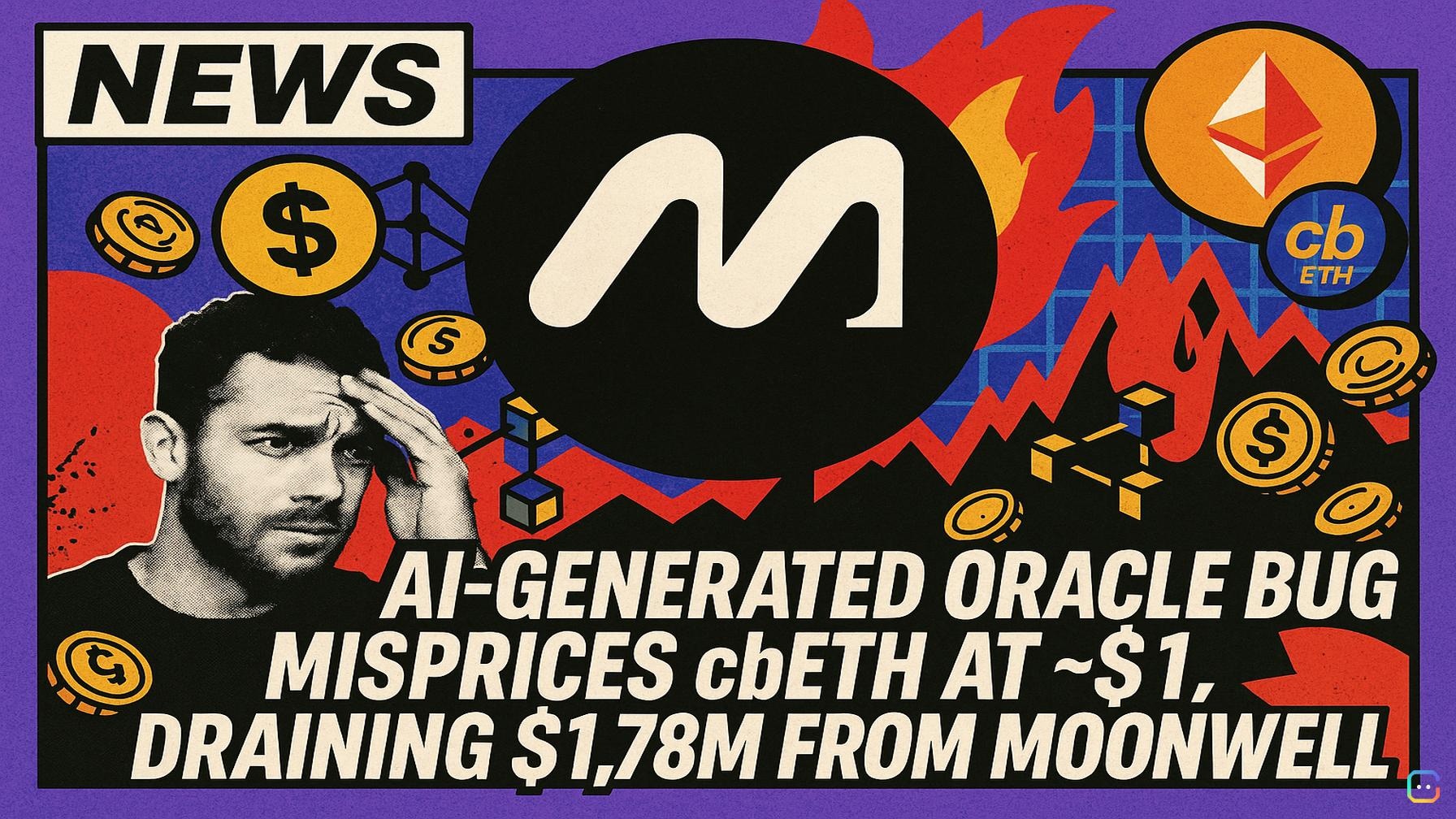
Headline: Moonwell Loses $1.78M After AI-Generated Oracle Logic Misprices cbETH at ~$1
Moonwell, a decentralized lending protocol, lost roughly $1.78 million after a Chainlink-based price update—reportedly using AI-generated logic—mispriced Coinbase-wrapped ETH (cbETH) at about $1 instead of roughly $2,200. The error allowed bots and liquidators to borrow against massively underpriced collateral and drain affected lending pools within hours.
What happened
- A recent oracle update contained faulty calculation logic that introduced an incorrect scaling factor in the cbETH price feed. The mispricing was reported as roughly $1.12 versus the correct price near $2,200.
- The bad math collapsed collateral requirements for the affected pools. Attackers rapidly borrowed assets against the undervalued cbETH before the error was detected and corrected, producing about $1.78M in bad debt.
- Moonwell’s preliminary investigation attributes the flawed code to logic generated by the AI model Claude Opus 4.6, rather than to a malicious external data feed or traditional oracle manipulation.
Why this matters
Price oracles are a critical backbone of DeFi lending: they determine collateral values and liquidation thresholds. Historically, many major DeFi losses stem from oracle manipulation or pricing errors rather than flaws in on-chain protocol fundamentals. This incident stands out because the vulnerability appears to come from AI-assisted code generation introducing a numeric/scaling bug—an emerging and distinct risk vector.
Broader implications
- AI-assisted development can accelerate engineering workflows, but financial smart contracts demand absolute precision in unit handling, scaling, and edge-case validation. Small arithmetic mistakes can have outsized, systemic consequences in lending systems.
- Auditing and security practices may need to evolve to account for AI-generated code: verifying not just code correctness but also provenance, numerical invariants and generation logic.
- As Web3 teams increasingly rely on automated coding tools, auditors and security firms warn that existing frameworks aren’t yet fully adapted to validate AI-produced contract components.
Bottom line
Moonwell’s $1.78M loss is a reminder that automation and AI can introduce novel failure modes in DeFi. The incident underscores the need for stricter numerical checks, more rigorous auditing of generated code, and updated security practices that specifically address AI-assisted smart-contract development.
Read more AI-generated news on: undefined/news