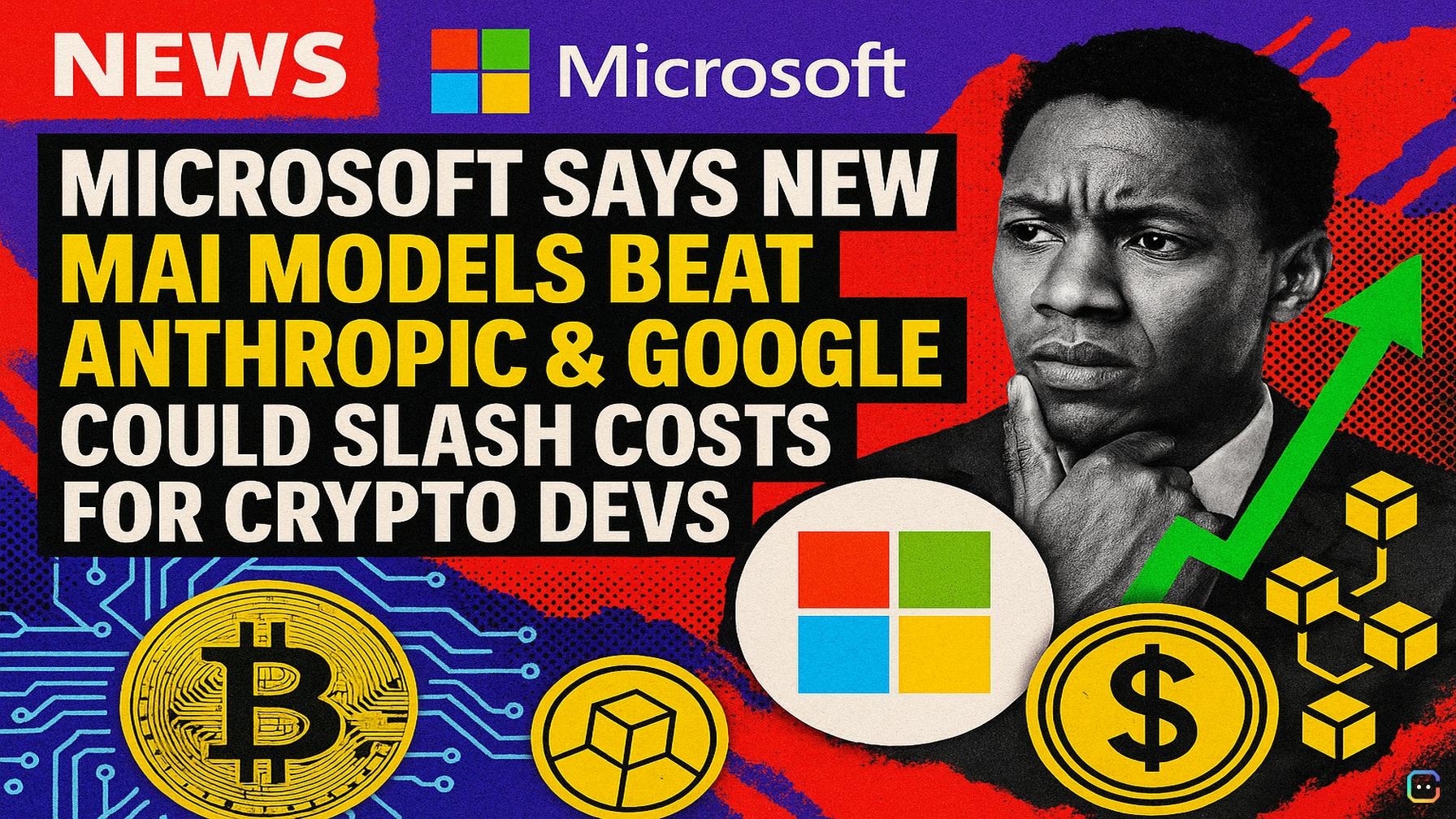
Microsoft rolls out seven “MAI” models, says they beat Anthropic and Google — and they could matter for crypto builders
At Microsoft Build on Tuesday the company unveiled seven new MAI models and made bold performance claims: Microsoft says its new models outperformed Anthropic’s Claude Sonnet 4.6 and Google’s Nano Banana family (including Nano Banana 2 and Nano Banana Pro on image-editing tests) in blind evaluations and image-editing benchmarks. The push marks Microsoft’s effort to present itself not just as OpenAI’s largest backer and cloud provider, but as a front-line creator of foundation models.
What Microsoft announced
- Flagship reasoning model: MAI-Thinking-1 — presented as Microsoft’s main text foundation model. Microsoft says independent blind tests preferred it to Anthropic’s Claude Sonnet 4.6, and that it scored 97% on AIME 2025 (a reasoning/problem-solving benchmark). The company also reports competitive SWE Bench Pro coding results, close to Anthropic’s Opus 4.6.
- Developer/code model: MAI-Code-1-Flash — a lightweight coding model built for GitHub Copilot and Visual Studio Code.
- Image models: MAI-Image-2.5 and MAI-Image-2.5-Flash — Microsoft claims these outperform Google’s Nano Banana Pro on image-editing tasks.
- Speech/transcription: MAI-Transcribe-1.5 (43 languages) and MAI-Voice-2 (natural-sounding speech in 15 languages and speaker adaptation from short samples).
- Common themes: Microsoft says the family was built “from scratch on a clean data lineage,” optimized for efficiency, and designed to work together.
Key claims and context
- Cost and quality: Microsoft stated MAI “delivered the highest win rate, outperforming GPT-5.5 on quality, while being 10x lower on cost.”
- Scale outlook: Microsoft AI CEO Mustafa Suleyman highlighted explosive growth in compute for frontier models — arguing training compute already rose by 1 trillion-fold and could jump another thousand-fold in three years, enabling “ever more effective AI.”
- Competitive backdrop: The announcement comes amid an active period for rival labs. Anthropic recently launched Opus 4.8 and expanded its cybersecurity-focused Mythos model through Project Glasswing; Google showcased its multimodal Gemini Omni and related model suite at I/O.
Why crypto and Web3 developers should care
- Faster, cheaper codegen: A lightweight Copilot-targeted model (MAI-Code-1-Flash) could streamline smart-contract development, auditing, and dApp iteration — potentially lowering friction for teams shipping on tight timelines.
- Creative tooling for NFTs and metaverse assets: Stronger image-editing models lower the barrier to producing and iterating NFT art, game assets, and virtual-world content.
- Multilingual & voice features for global DAOs and UX: Transcription and adaptable synthetic voices help international communities, on-chain governance conversations, and immersive metaverse experiences.
- Cost and deployment: If Microsoft’s cost claims hold up in practice, lower-cost inference matters for apps that need frequent AI calls (bots, analytics, on-prem or edge deployments). That could affect choices between cloud-hosted models, lightweight local inference, or hybrid on-chain/off-chain architectures.
- Strategic independence: Microsoft building its own foundation models signals more options for teams that previously leaned on OpenAI-powered tooling via Azure — relevant for projects weighing vendor lock-in, data governance, or custom-model needs.
Caveats
- Microsoft’s performance claims are company statements and based on the tests it cited (blind evaluator preference, benchmarks like AIME 2025 and SWE Bench Pro). Independent third-party reviews and broader real-world testing will be key to validating those wins.
- Practical integration, latency, pricing, and developer tools will determine how quickly crypto projects adopt these models.
Bottom line
Microsoft’s MAI family is a clear bid to be a first-tier model developer, not just an infrastructure partner. For the crypto and Web3 community, the new models promise faster dev workflows, richer media tooling, and lower-cost inference — but teams should wait for independent benchmarks, pricing details, and hands-on tests before switching production stacks.
Read more AI-generated news on: undefined/news