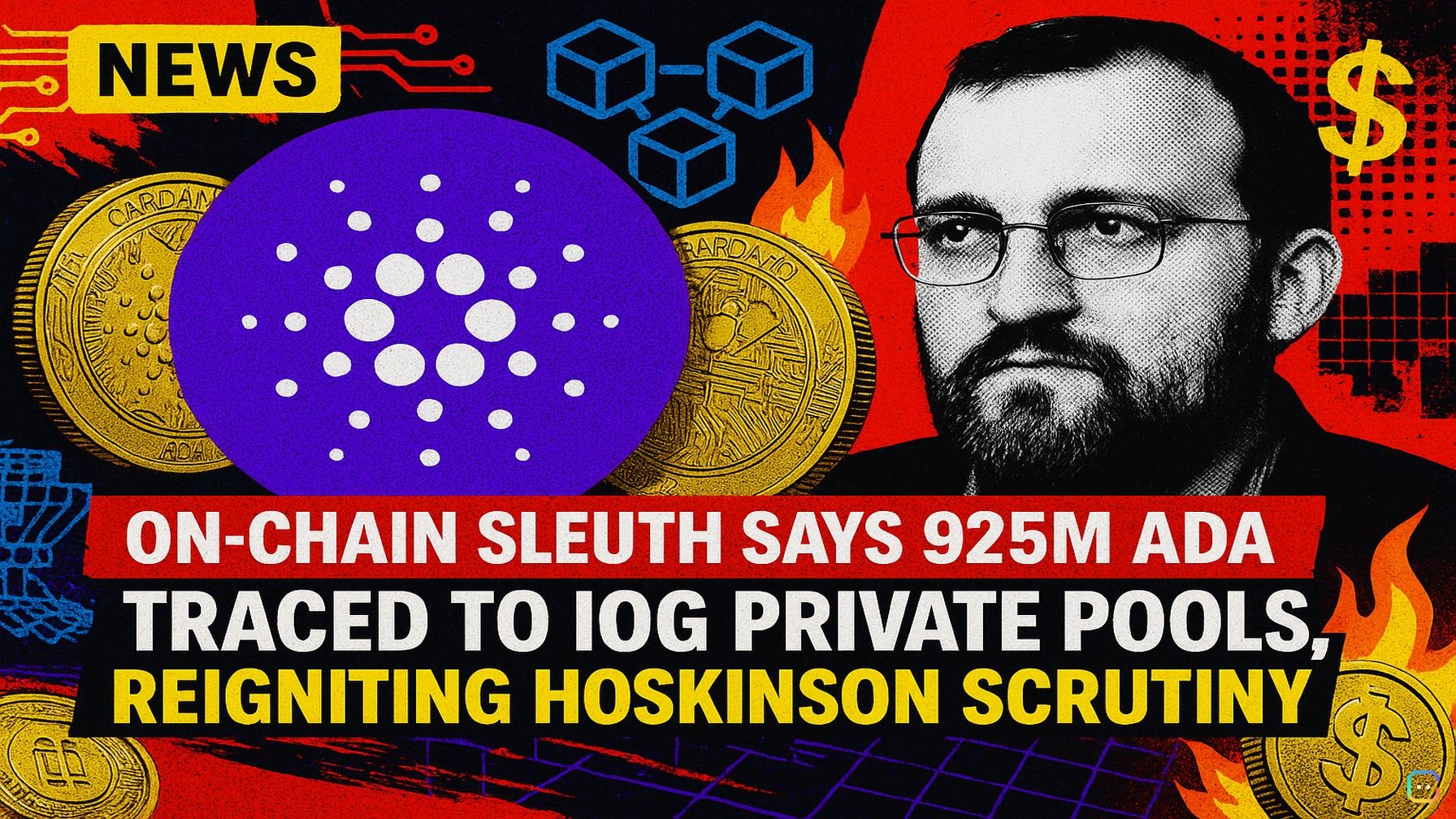
Charles Hoskinson, Cardano’s co-founder, is once again at the center of scrutiny after NFT creator and on-chain sleuth Masato Alexander published fresh tracing data that he says links large ADA movements during the 2021 bull run to entities connected to Cardano’s early infrastructure.
Alexander — who rose to prominence during last year’s voucher controversy — posted on X that his updated analysis shows Input Output Global (IOG) had a larger on-chain footprint than just the Genesis UTxO. He notes IOG operated multiple stake pools over the years, and because Cardano’s UTxO model and staking mechanics require pool owners and pledged ADA, those pools create additional tracing vectors for funds.
Key claims from Alexander’s report
- His tracing suggests a 925 million ADA transaction and nine separate 20 million ADA payments share a closer common ancestor than IOG’s Genesis ADA.
- That link, he says, reduces the number of intermediary “hops” between IOG and those transactions from roughly 40 to between one and seven.
- He also claims these transactions aggregate about 21 million of the roughly 64 million ADA that had been pledged in IOG’s private pools.
- Alexander published a detailed transaction graph, a hop-by-hop trace, an interactive flow map and raw Cardanoscan identifiers to support his working theory — while stressing the work is a “best effort” and not a legal determination of intent or control.
Important caveat: on-chain ancestry ≠ control
The new material traces transaction ancestry and common funding paths, but it does not by itself prove who controlled each wallet, whether funds were exchanged on external platforms, or the contractual context for any transfers. Alexander explicitly invited corrections and said he’d update his findings if errors were identified.
How this ties into prior allegations and responses
Alexander’s renewed tracing echoes an earlier allegation that Hoskinson used “genesis keys” during the Allegra hard fork in 2021 to move or “sweep” old ICO and voucher-related UTxOs — roughly 318 million ADA — into Cardano reserves or treasury rather than leaving them immediately claimable by voucher holders. Hoskinson denied those claims, asserting IOG did not appropriate hundreds of millions of ADA and that most vouchers were redeemed.
A subsequent Cardano redemption transparency report concluded the allegation had “no basis,” stating that 99.2% of vouchers representing 99.7% of ADA sold through the voucher program were redeemed. According to the report, when Byron-era on-chain redemption ended, 390 vouchers representing about 318 million ADA remained unredeemed and were swept into the reserve, while a post-sweep redemption process continued.
Parallel scrutiny into governance and early foundations
Separately, Thomas Braziel of 117 Partners surfaced Isle of Man filings related to Cardano’s earliest foundation structure. He says the documents show an initial foundation involving Hoskinson, Jeremy Wood and Ken Kodama, with later filings naming Hoskinson as the foundation’s “Enforcer.” Under Isle of Man foundation law, an Enforcer is an active oversight role charged with ensuring a council follows the foundation’s purposes and governance documents, not merely a ceremonial title.
Braziel has posed a series of questions — not framed as allegations of wrongdoing — about who controlled the Isle of Man foundation, what happened to historical allocations (he cites roughly 1,090 BTC noted in historical materials), how development agreements were negotiated, and what protections existed for ICO participants. He also highlights timing: Cardano’s ICO began in September 2015, while the Swiss Cardano Foundation was not established until September 2016.
Where things stand
Alexander’s new on-chain analysis revives unresolved questions about Cardano’s early distribution, governance arrangements and the transparency of large ADA movements during a formative market cycle. But tracing lineage on-chain is one thing; proving operational control, intent or contractual arrangements typically requires off-chain records and corroborating documentation.
At the time of publication, ADA was trading at about $0.16.
Read more AI-generated news on: undefined/news