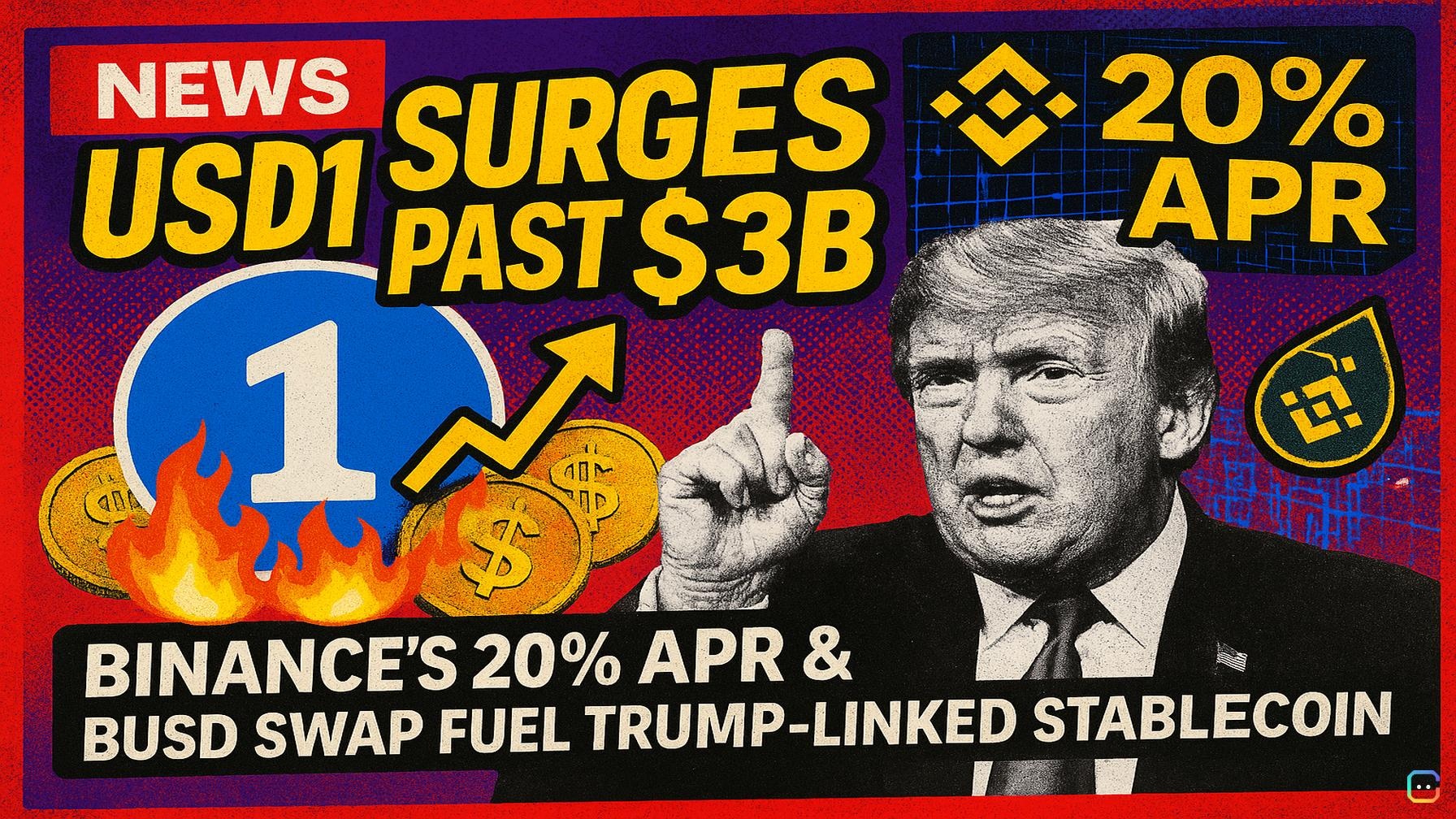
USD1 — the politically charged stablecoin issued by World Liberty Financial (WLFI) — has surged past the $3 billion mark, thrusting it into the upper ranks of the stablecoin world and reshaping liquidity dynamics across exchanges.
Key figures and ranking
- USD1 is now valued at about $3.12 billion, making it the sixth-largest stablecoin and the 32nd-largest cryptocurrency overall.
- That rapid ascent has turned the Trump-linked token into a major liquidity magnet on trading platforms.
What’s driving the surge
- Binance’s new “Booster Program” has been a primary catalyst. The exchange is offering a 20% APR on certain flexible-earn products tied to USD1 — far above typical stablecoin yields — creating strong demand.
- Binance has also converted the collateral for its BUSD-pegged tokens into USD1 at a 1:1 ratio, effectively making USD1 a core stablecoin inside Binance’s ecosystem. That move guarantees USD1 use in high-volume trading and lending on the exchange and funnels substantial liquidity into the token.
WLFI’s strategy and partnerships
- WLFI frames USD1 as a payment-first stablecoin focused on real-world usage and distribution rather than pure speculation. The project highlights institutional integrations and retail access as central pillars of growth.
- The team describes the $3 billion milestone as important but not the endpoint — their stated mission remains building the “financial rails” for broader adoption. Co-founder Zach Witkoff has also publicly celebrated the milestone.
- Strategic partnerships include Coinbase and FalconX, which provide retail and institutional distribution channels. WLFI is also targeting on-chain capital on Solana by teaming up with projects like Bonk and Raydium to capture flows that traditionally go to USDC.
Political flashpoints and controversy
- USD1’s rise has not been without controversy. Abu Dhabi’s MGX fund reportedly transferred $2 billion to Binance entirely in USD1 — a high-profile institutional use that coincided with political events in the U.S. around Binance’s co-founder. Shortly thereafter, former President Trump granted a full pardon to CZ, fueling speculation and scrutiny in Washington.
- Senator Elizabeth Warren cited ties like these in her opposition to the proposed GENIUS Act, warning that crypto policy could be swayed by political linkages. Critics argue the bill, as drafted, could lack sufficient safeguards to prevent private projects from benefiting disproportionately from government decisions.
What’s next — risks and tests
- WLFI currently benefits from strong institutional backing and the deep liquidity Binance provides. However, with GENIUS Act-related regulatory changes looming and the Booster Program’s outsized 20% APR playing a key role in demand, WLFI faces a test: can USD1 hold its roughly $3 billion market cap once the extraordinary incentives ease or regulatory pressure increases?
- The project is walking a delicate line between rapid growth powered by exchange incentives and the need to demonstrate sustainable, payments-driven adoption.
Note: This summary is informational and not investment advice. Cryptocurrency investments carry significant risk; readers should perform their own research before making financial decisions.
Read more AI-generated news on: undefined/news