Today's Cryptocurrency Prices by Market Caps
The global cryptocurrency market cap today i $2.42T
Market Cap
$2.42T
24h Trading Volume
$95.18B
BTC Dominance
56.58%
|
#
|
Name
|
Price
|
1h %
|
24h %
|
7d %
|
Market Cap
|
Volume (24h)
|
Chart (7d) |
|---|---|---|---|---|---|---|---|---|
|
|
—
|
|||||||
|
No cryptocurrencies found Try adjusting your search query |
||||||||
Latest Crypto News
View All News
Eightco Turns ORBS Into $321M Public Bet on Worldcoin and OpenAI
Eightco (Nasdaq: ORBS) has quietly reshaped itself into a highly concentrated, publicly traded play on two of the crypto/AI era’s biggest names: Worldcoin and OpenAI. In an early‑April filing and accompanying press materials, the company disclosed a $321 million balance sheet dominated by crypto tokens and an indirect stake in OpenAI, making it — by its account — “the largest publicly traded company by holdings within the Worldcoin ecosystem.” The disclosure positions Eightco as one of the most focused public vehicles for exposure to digital identity and artificial intelligence. Key holdings (as disclosed) - 277,222,975 WLD (Worldcoin): nearly 9% of circulating supply. At the reference price used in Eightco’s filing (~$0.25–$0.28 per WLD), this position is worth about $70–$78 million and is the largest single crypto exposure on the balance sheet. - 11,068 ETH. Held alongside WLD and stablecoins as part of a broader “digital asset position.” - $90 million indirect investment in OpenAI — approximately 30% of Eightco’s total treasury — linking roughly a third of its asset base to the AI lab behind ChatGPT. - $25 million stake in Beast Industries (associated with creator MrBeast). - Roughly $110 million in cash and stablecoins. Why it matters - Concentration: Worldcoin and the OpenAI stake together dominate Eightco’s risk and return profile. WLD alone represents a substantial, volatile bet given its outsized presence in the company’s treasury; OpenAI represents a large, non‑public tech exposure. - Strategic positioning: Eightco frames the portfolio as a deliberate play at “the intersection of artificial intelligence, digital identity, and next‑generation consumer ecosystems,” a narrative CEO Kevin O’Donnell highlighted in the announcement. - Funding runway: The company reiterated previously announced new funding commitments of $125–$130 million led by Bitmine, ARK Invest and Payward (Kraken), money it says will support expansion of its “high‑beta AI‑plus‑crypto” strategy. Bottom line Eightco’s filings turn the Nasdaq ticker ORBS into a direct way for public‑market investors to take concentrated exposure to Worldcoin and OpenAI. That positioning could deliver outsized upside if WLD or Eightco’s OpenAI exposure appreciates — but it also concentrates company risk around a small number of speculative assets, amplifying volatility for shareholders. Read more AI-generated news on: undefined/news
CME Adds AVAX and SUI Futures — Micro Contracts Open Altcoins to Institutional Traders
CME adds AVAX and SUI futures — including micro contracts — as institutions push deeper into altcoin trading CME Group said Monday it will expand its regulated crypto derivatives suite by listing futures on Avalanche (AVAX) and Sui (SUI), bringing both chains onto the same institutional trading shelf as Bitcoin, Ether and several large‑cap altcoins. The new contracts, which include both standard and micro sizes, are scheduled to start trading on CME Globex on May 4, subject to regulatory review. What’s launching - Avalanche futures: standard contract = 5,000 AVAX; Micro AVAX = 500 AVAX. - Sui futures: standard contract = 50,000 SUI; Micro SUI = 5,000 SUI. CME says the notional sizes are aimed at professional trading desks while the micro contracts let firms and sophisticated traders take smaller, more precise positions — mirroring the logic behind equity Micro E‑mini products that let market participants “fine‑tune exposure and manage risk with lower upfront capital.” Why it matters Adding AVAX and SUI to CME’s regulated offerings gives macro funds and crypto‑native institutions standardized, exchange‑cleared tools to hedge and express directional views on these networks. That’s significant as institutional demand for regulated crypto products has been rising: CME reported March average daily volume across its digital‑asset futures and options was up 19% year‑on‑year, with nearly $8 billion in notional traded per day. “This rollout of micro‑ and larger‑sized Avalanche and Sui futures will provide clients with greater choice, enhanced flexibility and more capital efficiencies across our deeply liquid, regulated crypto derivatives complex,” said Giovanni Vicioso, CME’s global head of cryptocurrency products. Isaac Cahana, CEO of Plus500US, added that the contracts “further broaden access for our global customers, allowing them to participate in evolving markets with greater flexibility and improved capital efficiency.” Broader trend Avalanche and Sui join a recent wave of altcoin contracts CME has listed — including Cardano, Chainlink and Stellar — alongside long‑running Bitcoin and Ether products. For altcoins, exchange‑traded futures can deepen price discovery, widen access for institutional players, and enable more refined basis and relative‑value strategies. For traders, the micro versions are particularly useful for hedging, testing strategies, or managing exposure with less capital. The contracts will begin trading May 4 on CME Globex, pending regulatory approval. Read more AI-generated news on: undefined/news
Samsung Stock Soars on AI HBM Boom — What Crypto Builders Need to Know
Samsung stock pops as AI chip boom drives record profits Samsung Electronics surged Tuesday after forecasting a monster quarter driven by exploding demand for AI hardware. Shares spiked as much as 4.8% intraday and closed up 1.76% after the company released preliminary results pointing to sharply higher profits and revenue. Big numbers: Samsung estimates first-quarter operating profit of about 57.2 trillion won (roughly $37.8 billion) — more than eight times year-ago profits and nearly three times its previous quarterly high. Analysts had been expecting 42.3 trillion won. Revenue is projected at roughly 133 trillion won, a nearly 70% year‑over‑year jump and the first time quarterly sales would top 100 trillion won. What’s driving it: The surge is primarily being fuelled by demand for high-bandwidth memory (HBM), the specialized memory used in accelerators from NVIDIA, AMD and other vendors that power large-scale AI training and inference. Data‑center expansion and rapidly growing AI model training have pushed memory requirements sharply higher, tightening supply and sending prices upward. Market impact and outlook: Industry watchers expect memory prices tied to data‑center applications to keep rising in the near term. “Samsung’s numbers are so huge they’re now rivaling the scale of global Big Tech,” said MS Hwang of Counterpoint Research. Hwang noted HBM demand has caused shortages across the memory market and estimated that commodity memory prices could climb by more than 50% in the second quarter amid continued supply tightness. Competitive dynamics: Samsung is also attempting to reclaim ground in the high‑bandwidth memory space after SK Hynix took an early lead supplying advanced AI memory. Samsung’s Device Solutions division — which includes its memory business — accounted for 39% of total revenue and 57% of operating profit in 2025, underscoring how central memory is to the company’s earnings. Risks to watch: Samsung will publish a full earnings report later this month, but risks remain. Rising tensions in the Middle East have started to disrupt semiconductor supply chains, delaying shipments of crucial inputs such as helium. The U.S.–Israel conflict involving Iran has heightened concerns about access to these materials. “If the Middle East conflict ends quickly, it will not significantly impact profits. However, if it persists for several months or longer, it will lead to severe consequences,” Hwang warned. Why crypto readers should care: The surge in AI hardware spending signals growing scarcity and higher prices for high-performance compute resources — dynamics that affect anyone building or running compute‑intensive applications, including AI-integrated blockchain projects and other crypto infrastructure that lean on specialized chips. Samsung’s blockbuster guidance highlights how the AI hardware boom is reshaping semiconductor economics — and it will be a key story to follow when the company releases full results later this month. Read more AI-generated news on: undefined/news
Dimon: AI Will Reshape Banking Fast — JPMorgan’s $19.8B Tech Bet Signals Crypto Shakeup
JPMorgan’s Jamie Dimon says AI will reshape banking — and fast Jamie Dimon is betting hard that artificial intelligence will remake banking far faster than past revolutions like electricity or the internet. In his latest shareholder letter, the JPMorgan Chase CEO called AI “transformational,” and warned its adoption could accelerate dramatically “over the next few years.” Big tech bets at the bank JPMorgan is already backing that view with scale. The bank plans to spend roughly $19.8 billion on technology in 2026 — covering AI, data systems, and cloud infrastructure — building on prior AI commitments. Dimon noted the firm had been investing about $2 billion a year in AI initiatives as of late 2025. “We will deploy AI, as we deploy all technology, to do a better job for our customers (and employees),” he wrote, arguing AI will touch “virtually every function, application, and process in the company” and drive long-term productivity gains. He also framed AI as having broad societal upside, saying it could help “cure some cancers, create new composites, and reduce accidental deaths.” Risks, oversight, and the middle path Dimon didn’t sugarcoat the dangers. He flagged deepfakes, misinformation, and cybersecurity vulnerabilities as real threats that could inflict lasting damage if mishandled. His prescription: preparation and balanced oversight. Companies, regulators, and governments should avoid two predictable mistakes, he argued—“overreact at the first serious incident and regulate out important innovation, or underreact and fail to learn from what went wrong.” Effective oversight, he warned, will require planning and “discipline to fix what’s broken without destroying what works.” Jobs and the labor market AI will reshape work, Dimon acknowledged: “AI will definitely eliminate some jobs, while it enhances others.” JPMorgan says it will try to redeploy affected employees where possible, even as demand for skilled roles—especially cybersecurity and AI development—stays strong. Those concerns are echoed across the tech world. Anthropic CEO Dario Amodei recently warned that advancements could wipe out up to half of entry-level professional roles within five years, describing engineers who now mainly edit model-written code. OpenAI has urged governments to prepare for automation-driven economic disruption by rethinking taxation, worker protections, and social safety nets. What this means for crypto For crypto firms and blockchain builders, Dimon’s letter is a clear signal: legacy finance is accelerating AI investment, and that will reshape payments, risk models, fraud detection, and product development. The same opportunities and risks—automation of routine tasks, increased demand for security expertise, and regulatory trade-offs—will play out in Web3. Firms that combine AI with strong security and thoughtful governance may gain an edge; those that ignore the technology or its risks could fall behind. Bottom line: JPMorgan is doubling down on AI and expects it to be transformational — but Dimon urges a careful, prepared approach to managing risks while preserving innovation. Read more AI-generated news on: undefined/news
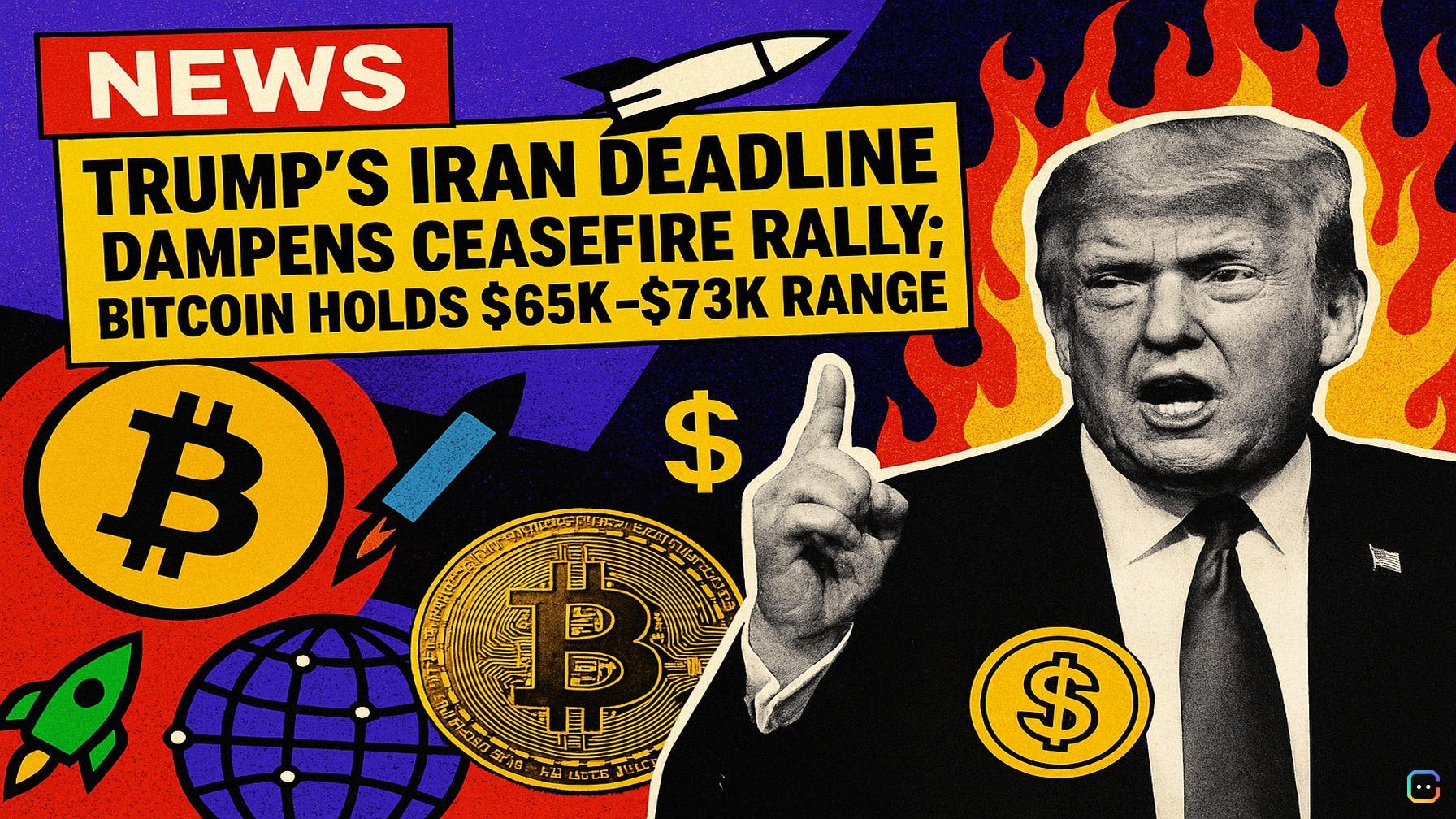
Trump's Iran Deadline Dampens Ceasefire Rally; Bitcoin Holds $65K–$73K Range
Bitcoin and major altcoins steadied Tuesday as a sudden ceasefire-driven rally faded and U.S. President Donald Trump set a hard deadline for Iran to accept a deal — warning that if it does not agree by Tuesday night he would “destroy every bridge in Iran by 12 o’clock tomorrow night.” Market moves - Bitcoin slipped to $68,589 in Asian hours, down about 0.6% over 24 hours after spiking to $69,350 on Monday. That jump followed an Axios report of a possible 45-day ceasefire, but the optimism lasted only around 12 hours. - Ether fell 1% to $2,104. - Solana’s SOL dropped 2.7% to $79.75. - XRP was down 1.6% at $1.32. - Dogecoin slid 2.2% to $0.09. - BNB remained relatively flat at $598. What drove the churn Crypto’s pattern over the past six weeks held true: brief bursts of risk-on sentiment on positive headlines are swiftly pared back by new negative developments. Diana Pires, chief business officer at sFOX, framed the action as positioning unwinding rather than a fundamental shift: “This move looks less like a shift in fundamentals and more like positioning getting caught offsides,” she said, noting bearish sentiment and elevated short interest ahead of the ceasefire report. Monday’s short-squeeze was measurable: roughly $196.7 million in short liquidations hit the market after the ceasefire news. The reversal came when Iran reportedly sent mediator Pakistan a rejection of the ceasefire proposal, demanding instead a permanent end to the war, sanctions relief, reconstruction aid and secure passage through the Strait of Hormuz. Energy, equities and macro backdrop Geopolitical tensions pushed oil higher — U.S. crude climbed above $112 and Brent traded near $115.66, up about 2.9% — after Trump warned the military could put every Iranian power plant “out of business” if no agreement is reached, even while saying talks were “going well.” Equities, however, showed resilience: the S&P 500 notched its longest run of gains since January despite the intraday whipsaw. Macro data added to the uncertainty. U.S. services activity slowed in March, employment contracted at the sharpest rate since 2023, and input prices accelerated — a mix that leaves the Fed without a clear impetus to cut rates or pause hikes. Key inflation prints this week are likely to sway markets further. Range-bound bitcoin Bitcoin continues to trade inside the $65,000–$73,000 band that has defined the market since the conflict began. Every rally has stalled near the top of the range and each sell-off has found support near the bottom. With Trump’s Tuesday midnight deadline approaching, traders will be watching whether the next catalyst pushes BTC to test the upper or lower boundary. Read more AI-generated news on: undefined/news
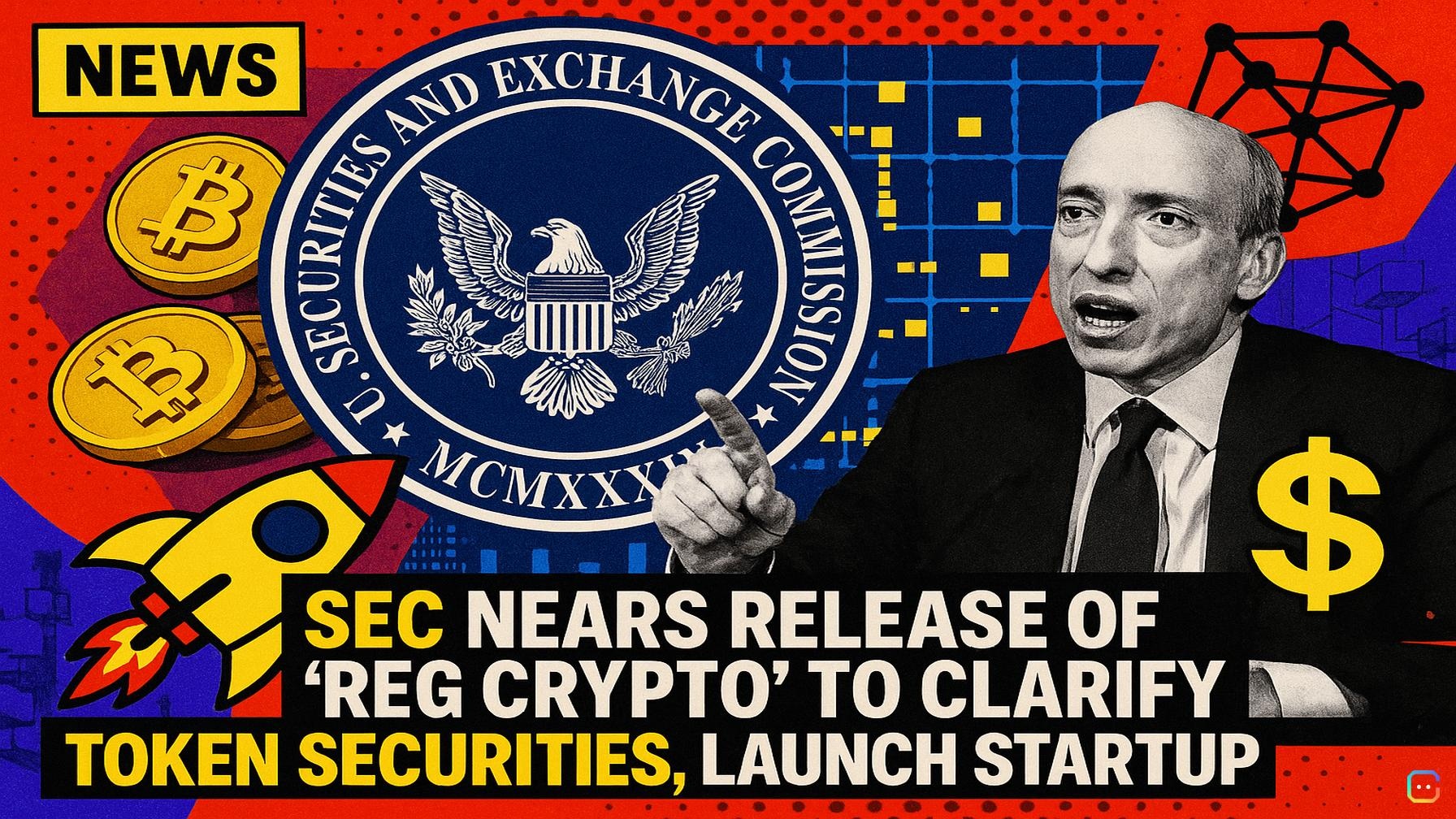
SEC Nears Release of 'Reg Crypto' to Clarify Token Securities, Launch Startup Exemption
SEC nearing release of “reg crypto” that aims to clarify fundraising rules, Chair Paul Atkins says The Securities and Exchange Commission is on the verge of publishing a landmark “regulation crypto” that will map out how the agency treats crypto activity under securities law, SEC Chair Paul Atkins told an audience in Nashville on Monday. Atkins said the proposed rulemaking, focused on the Securities Act of 1933 and aimed at clarifying which token sales and other crypto transactions qualify as securities, is currently sitting with the White House Office of Information and Regulatory Affairs (OIRA) — one step away from being made public. The package will tackle fundraising and startup exemptions, among other issues, he said at an event hosted by Vanderbilt University and the Blockchain Association. He also told CoinDesk after his session that the SEC plans to roll out its much-anticipated “innovation exemption” soon. The exemption, Atkins said, is designed to help startups experiment without putting incumbents at a disadvantage. “We want people really to experiment within [that] framework,” he said, adding that the agency wants feedback once it’s in operation: “We'd love to have reactions and everything else. It's not a rule as such but obviously we need to know how it's functioning and if people have problems with it or not.” Atkins repeatedly stressed that the commission is moving forward with rulemaking regardless of legislative developments on Capitol Hill. “I think we have enough of a runway now, even notwithstanding what may happen in the midterms — although I really still want a friendly Congress obviously — they can throw tacks on the road in front of our tires but they're not going to really slow us down,” he said. He also urged the crypto community to engage in the upcoming election cycle, citing Senator Bernie Moreno as an example of the kind of congressional presence the sector should support. “To have Congress really veer off track is not going to any of us any good, and it's going to put a lot more questions into the future because people then just have ‘oh gosh, maybe this is again a passing phase,’” Atkins said. “We've got to make sure that your friends are in Congress. I think you saw how that really paid benefits in the last election.” What’s next: With the reg crypto in OIRA review, publication and a public comment period could follow. The industry can expect a clearer framework for distinguishing securities from non-securities transactions in crypto, plus new carve-outs intended to foster startup experimentation — and the SEC appears to be inviting industry input on how those carve-outs perform in practice. Read more AI-generated news on: undefined/news