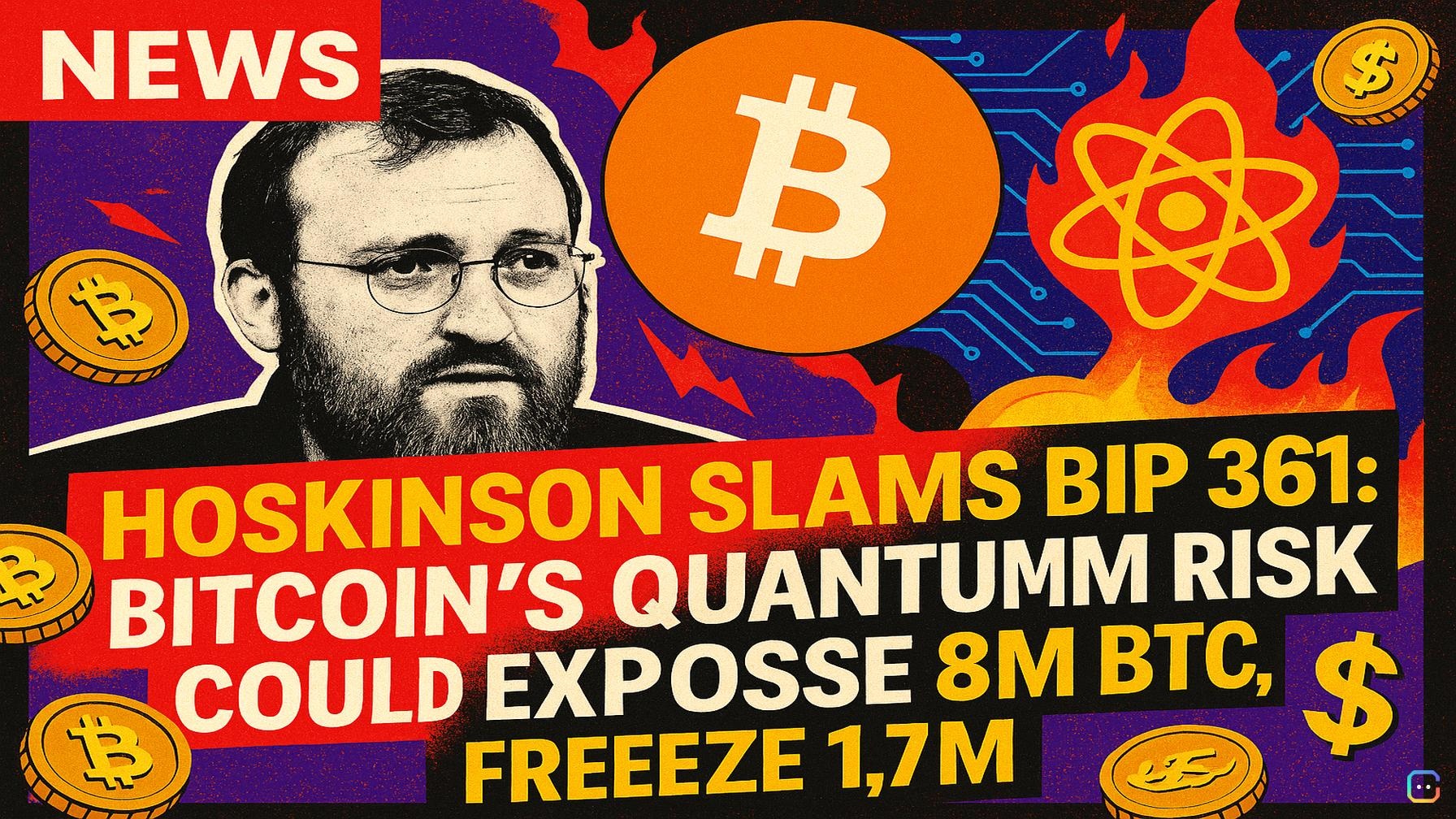
Cardano founder Charles Hoskinson used a fiery livestream to argue that Bitcoin’s resistance to structural change has left the network dangerously exposed to an emerging quantum-computing threat — and that the community’s governance model, not only its cryptography, is the root of the problem.
In a session titled “BIP 361: Welcome to ShitcoinLand, Bitcoin,” Hoskinson framed BIP 361 as an implicit admission from parts of the Bitcoin ecosystem that quantum risk is now a practical concern. He pointed to language in the proposal stating that, as of March 1, 2026, more than 34% of all BTC had revealed their public keys on-chain — a condition that, in his view, leaves roughly 8 million BTC vulnerable to theft by an attacker with a sufficiently powerful quantum computer.
What BIP 361 would do, Hoskinson explained, is effectively freeze any bitcoin that does not migrate to a quantum-safe address within five years of activation. That freeze would be enforced by consensus, meaning coins belonging to people who are incapacitated, imprisoned, or simply unaware of the deadline could be rendered unspendable rather than stolen.
Hoskinson’s critique focused on two linked technical and governance claims:
- He argued the proposal’s implied response would require a hard fork in practice, even if it’s not labeled that way.
- He said forced migration to post-quantum addresses would leave large swaths of coins held in older wallet formats permanently inaccessible under the recovery proof system the proposal envisions.
“As of March 1st, 2026, over 34% of all Bitcoin have revealed public key on chain… those UTXOs could be stolen by an attacker with sufficiently powerful quantum computer. 34% of all Bitcoin is vulnerable. About 8 million Bitcoin, give or take,” Hoskinson said on the stream.
That observation led to his central dilemma: either accept leaving legacy coins exposed to theft in the 2030s, or undertake a migration that effectively freezes older coins. Hoskinson estimated about 1.7 million BTC would fall into the latter category — including roughly 1.1 million BTC he attributes to Satoshi Nakamoto — because those outputs predate hierarchical deterministic (HD) wallet standards and seed-phrase recovery schemes the proposal relies on.
“Users with frozen quantum vulnerable funds and an HD wallet seed phrase can construct a quantum safe proof to recover funds,” he paraphrased the proposal’s logic, then rejected it forcefully: “That’s a lie. And you know it. You know it. 1.7 million coins can’t do that. It’s not possible.”
Beyond the technical critique, Hoskinson expanded the argument into a broader attack on Bitcoin’s social infrastructure. He said years of maximalist doctrine — the insistence that Bitcoin must remain immutable and minimal — have hardened into a culture that resists the very kinds of coordinated protocol changes the network may now need. In his view, that ideological frame has turned software design decisions into dogma, making adaptation politically fraught and technically awkward.
“What happened to there is only ever going to be 21 million coins and self-custody and Bitcoin never needs to change and everything’s perfect?” he asked. “Because here’s the thing, it’s not a bad proposal. It really isn’t. I understand why they wrote it. Because if they don’t do this, that money will be stolen in the 2030s.”
Hoskinson contrasted Bitcoin’s informal, consensus-driven governance with the formal on-chain governance mechanisms used by networks such as Cardano, Polkadot, and (in different forms) Ethereum. He argued those systems provide clearer paths to resolving upgrade disputes and making hard tradeoffs when threats emerge. “If you had onchain governance, you could solve it,” he said. “We have it at Cardano. Polkadot has it… it’s a good idea.”
At press time, Cardano was trading at $0.2499.
Read more AI-generated news on: undefined/news