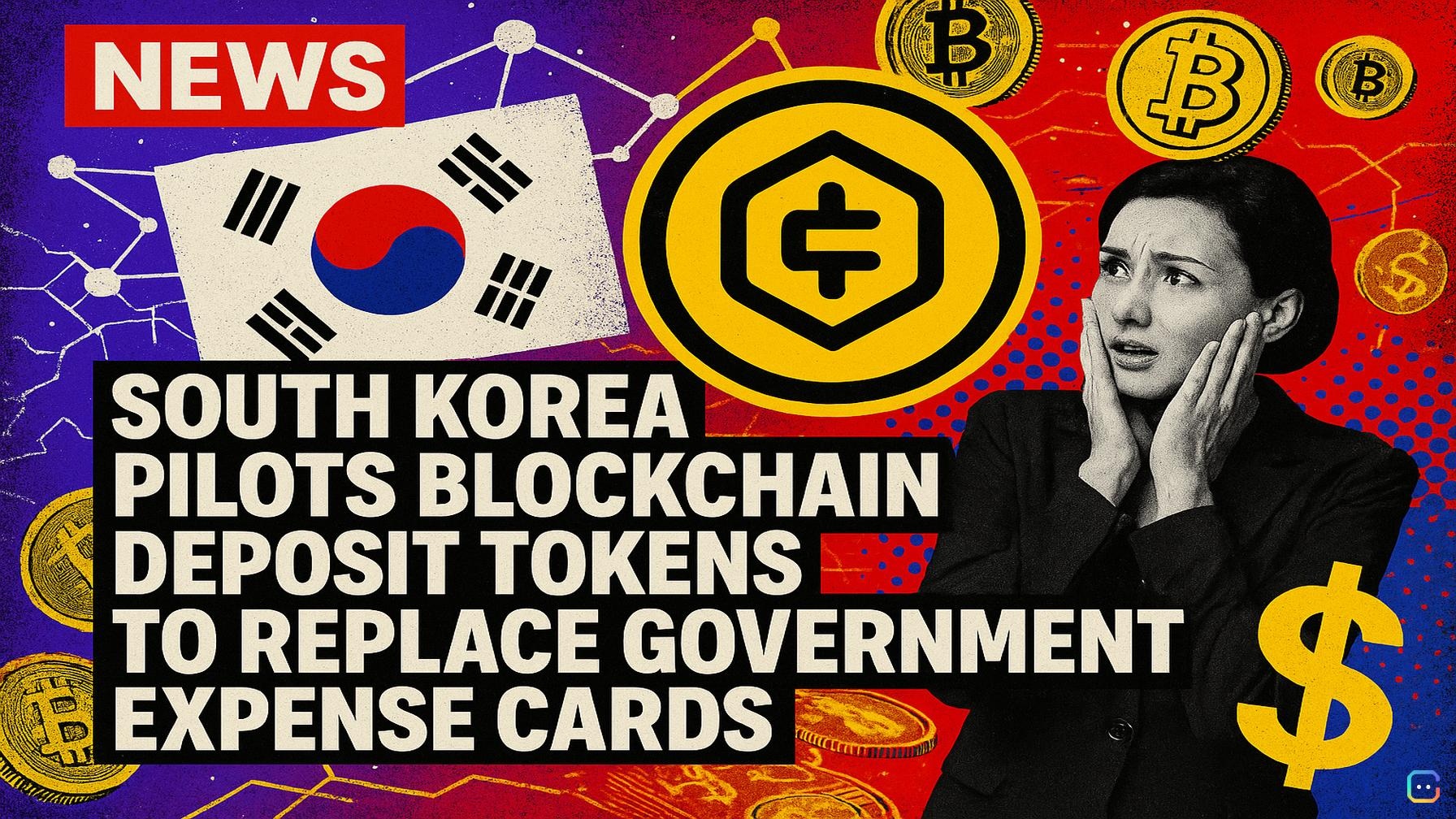
South Korea is piloting blockchain-based deposit tokens to replace government expense credit cards, the Ministry of Economy and Finance said in an official press release.
What’s happening
- The government has approved a regulatory sandbox to run a pilot that executes national treasury payments using deposit tokens issued on permissioned blockchains. This is the second time Seoul has used deposit-token tech for public spending, following a prior pilot with the Ministry of Environment for EV‑charging infrastructure and subsidy payments.
What deposit tokens are
- Deposit tokens are tokenized claims on commercial bank deposits issued on private (permissioned) blockchain rails. In practice they’re digital versions of money already held in bank accounts: banks “wrap” deposits into tokens that citizens and businesses can spend with approved merchants and service providers via the blockchain — similar to card or mobile-wallet payments but tokenized and programmable.
- Unlike CBDCs, which are central‑bank‑issued digital currency, deposit tokens are bank‑issued, and offer programmable settlement, transparent tracking of public funds, and real‑time reporting that can help government oversight.
Why the sandbox matters
- Under the current National Treasury Funds Management Act, business-promotion costs and related operating expenses must be paid with government purchase cards, effectively banning deposit-token use. The sandbox lifts that restriction for this pilot, creating a real‑world testbed for blockchain-based fiscal execution.
- Officials say the system can preset and control spending windows and permitted vendor categories when business promotion expenses are paid with deposit tokens. That should boost transparency and, by cutting intermediaries, eliminate card-processing fees currently charged to small merchants.
Bigger context and implications
- The pilot arrives as South Korea continues work on the Digital Asset Basic Act, a sweeping regulatory framework for stablecoins, tokenized real‑world assets, and crypto ETFs. The National Policy Committee recently postponed the “second phase” of debates until after local elections on June 3.
- Trade‑offs are clear: greater efficiency, programmability and state control versus reduced privacy and the risk of regulatory overreach. Expect momentum for bank‑chain infrastructure, permissioned blockchain providers, and tokenization narratives.
- If scaled, these state-backed, bank‑issued tokens could gain preferential on‑chain flows over fully open stablecoins — reshaping liquidity, FX corridors, and on‑chain yield strategies. A successful rollout could make South Korea a reference model for how blockchains can handle real‑world fiscal flows.
Image credits: Cover image from Perplexity. BTCUSD chart from TradingView.
Read more AI-generated news on: undefined/news